

Written by Tina Jiang, Director at Spare Center
Tina Jiang is the Sales Director at Spare Center and brings more than 12 years of experience in the automation industry. Over the years, she has worked closely with a wide range of clients and gained a practical understanding of automation technologies, market trends, and real-world customer needs.
Her work focuses on building long-term client relationships and supporting business growth across different markets. With a hands-on approach and solid industry experience, she enjoys sharing insights that come from day-to-day work in the field.
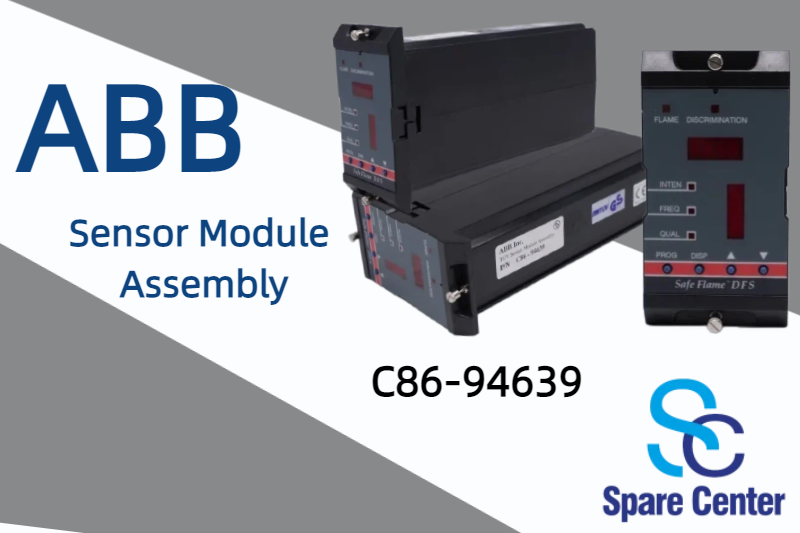
Introduction If you spend enough time around industrial control cabinets, you’ll notice a pattern: most system problems don’t come from the controller itself. They come from signals that aren’t as clean as people assume. That’s where the ABB C86-94639 Sensor Module Assembly quietly earns its place. It’s part of ABB’s signal handling chain, sitting between field instruments and the controller, making sure what comes in from the plant floor is actually usable. In real terms, it acts like a signal conditioning module and also an industrial sensor interface—two roles that sound simple on paper, but are extremely important once you’re dealing with long cable runs, VFD noise, and unstable grounding in the field. What the ABB C86-94639 Is Actually Doing Inside the SystemThe ABB C86-94639 Sensor Module Assembly is typically used in analog signal environments where stability matters more than anything else. Most industrial sensors feeding into ABB systems use standard signals such as:
On a clean bench, these signals look perfect. In a real plant, they don’t. Motor drives switching nearby, long cable routing through trays, and grounding differences all introduce noise. Without proper handling, a 12.00 mA signal might suddenly look like 11.7 mA or jump slightly during load changes. That’s enough to confuse a control loop. This is where the ABB C86-94639 Sensor Module Assembly acts as a signal conditioning module. It filters and stabilizes these inputs before they reach the controller side, essentially cleaning up the signal so the system doesn’t react to electrical noise. It also works as an industrial sensor interface, providing electrical separation between field wiring and the control electronics. In many ABB architectures, this isolation is typically designed in the kilovolt range at system level (commonly 1.5–2.5 kV isolation depending on configuration), which helps protect the control side from spikes and transient disturbances. From a design perspective, this is also where PLC signal stabilization really happens—not in the PLC itself, but upstream at the module level. |
|
Why It Matters More Than People Realize
Ask any maintenance engineer and they’ll tell you: the hardest faults are not the broken ones, but the “almost wrong” signals.
That’s exactly the kind of problem the ABB C86-94639 Sensor Module Assembly helps reduce.
When acting as a signal conditioning module, it smooths out small fluctuations that would otherwise trigger false alarms. For example, a flow transmitter bouncing between 9.8 and 10.2 mA due to noise might cause unnecessary control corrections if not stabilized properly.
With a proper industrial sensor interface in place, the system sees a much steadier value, which improves overall PLC signal stabilization across the loop.
Another real-world advantage is troubleshooting time. In plants without proper conditioning, technicians often spend hours checking sensors, cables, and grounding points. With the ABB C86-94639 Sensor Module Assembly, signal issues are often easier to isolate—because the signal entering the controller side is already standardized and filtered.
It also reduces “false engineering work”—situations where teams adjust control logic when the real issue is actually electrical noise in the field.
Operational Stability Over Time
One thing that often gets overlooked is how much strain unstable signals put on a system over time.
Without proper PLC signal stabilization, controllers may continuously adjust outputs based on fluctuating inputs. That leads to:
unnecessary actuator movement
valve hunting
increased wear on mechanical components
By using the ABB C86-94639 Sensor Module Assembly as a signal conditioning module, the system avoids reacting to noise and instead responds to real process changes.
This is especially important in continuous production environments, where even small instabilities can compound into larger efficiency losses.
In ABB-based systems, the analog input module ABB architecture depends heavily on this front-end signal stability. The cleaner the input, the more predictable the control behavior downstream.
Conclusion
The ABB C86-94639 Sensor Module Assembly is not a complex device in the way modern controllers are, but it solves a problem that shows up in almost every real industrial site: unreliable signal quality.
By working as a signal conditioning module and industrial sensor interface, it plays a direct role in PLC signal stabilization and protects the control system from the messy reality of the plant floor.
In practice, it doesn’t make machines faster or smarter—but it makes them more stable. And in industrial automation, stability is usually what matters most.
Recommended Models
| AO610 3BHT300008R1 | 88FN02B-E GJR2370800R0200 | DSQC611 3HAC13389-2 |
| DP620 3BHT300016R1 | 88FV01E GJR2332300R0200 | DSQC637 3HAC023047-001 |
| PM510V08 3BSE008373R1 | 88UB01A GJR2322600R0100 | DSQC658 3HAC025779-001 |
| SR511 3BSE000863R1 | 3BHE004573R0141 UFC760 BE141 | SNAT608CMT |
| DSAI146 3BSE007949R1 | 3BHE004573R0142 UFC760 BE142 | SDCS-CON-2A 3ADT309600R0002 |
| DSAI155A 3BSE014162R1 | CI810V2 3BSE013224R1 | SDCS-COM-81 3ADT314900R1002 |
| NPCT-01C 64009486D | DI814 3BUR001454R1 | PU516 3BSE013064R1 |
| 81AA03A-E GJR2394100R1210 | SB512 3BSE002098R1 | SD822 3BSC610038R1 |
| 87TS01I-E GJR2368900R2550 | CI840 3BSE022457R1 | TU845 3BSE021447R1 |
| 87TS01K-E GJR2368900R2200 | SD812 3BSC610023R0001 | AI895 3BSC690086R1 |
ABB C86-94639 Sensor Module Assembly – Technical FAQ (Spare Center Edition)
Q1: What is the primary engineering function of the ABB C86-94639 Sensor Module Assembly within ABB control architectures?
It serves as a precision signal interface module responsible for conditioning and transmitting field sensor data into stable control-system inputs.
Q2: Which signal categories are typically supported by the ABB C86-94639 Sensor Module Assembly?
It is commonly designed to handle standard industrial signals such as 4–20 mA current loops and 0–10 V analog inputs, depending on system configuration.
Q3: How does the ABB C86-94639 Sensor Module Assembly contribute to signal integrity in noisy environments?
It applies internal signal conditioning and filtering mechanisms to suppress electromagnetic interference and stabilize fluctuating field inputs.
Q4: What role does the ABB C86-94639 Sensor Module Assembly play in system-level data accuracy?
It ensures signal fidelity preservation between field devices and control logic, reducing deviation caused by cable resistance or electrical noise.
Q5: Does the ABB C86-94639 Sensor Module Assembly provide electrical isolation?
Yes, it typically incorporates galvanic isolation architecture to separate field-side disturbances from sensitive control electronics.
If you want to more details,please contact me without hesitate.Email:sales@sparecenter.com
#Petroleum spare parts #Power plant spare parts #Steam turbine spare parts #ABB modules (signal conditioning module signal conditioning module signal conditioning module signal conditioning module PLC signal stabilization PLC signal stabilization PLC signal stabilization PLC signal stabilization PLC signal stabilization PLC signal stabilization PLC signal stabilization analog input module analog input module analog input module analog input module analog input module analog input module analog input module analog input module analog input module analog input module analog input module analog input module analog input module)