
Written by Tina Jiang, Director at Spare Center
Tina Jiang is the Sales Director at Spare Center and brings more than 12 years of experience in the automation industry. Over the years, she has worked closely with a wide range of clients and gained a practical understanding of automation technologies, market trends, and real-world customer needs.
Her work focuses on building long-term client relationships and supporting business growth across different markets. With a hands-on approach and solid industry experience, she enjoys sharing insights that come from day-to-day work in the field.
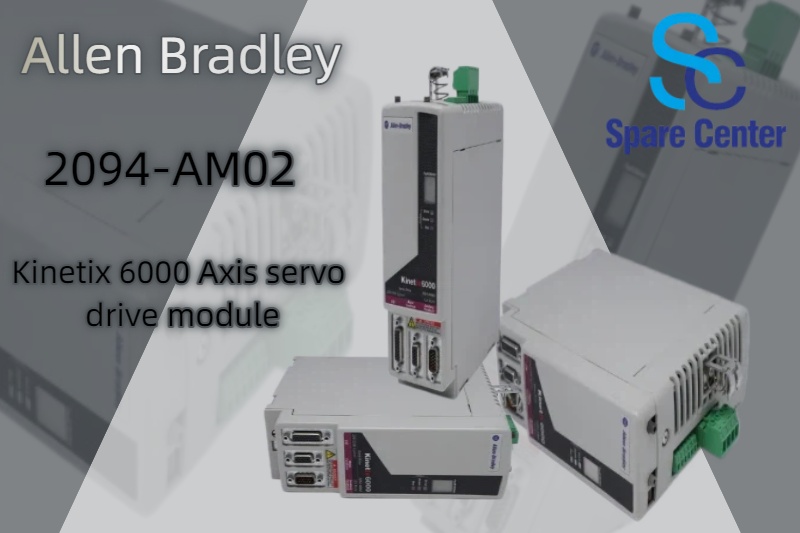
Introduction In a lot of factories, you don’t really hear engineers talking about servo drives in a flashy way. It usually comes up only when something stops working or when a line is being rebuilt. The Allen Bradley 2094-AM02 Kinetix 6000 Axis servo drive module, from Rockwell Automation, is one of those components that tends to stay in the background. It’s part of the Kinetix 6000 servo system, which has been around long enough that most maintenance teams already know how it behaves. Even now, you still find it running in older but stable production lines. Not because it’s “legacy technology,” but because nobody wants to touch a system that is already running smoothly. How Multi-Axis Motion Control Feels on the Shop FloorOn paper, multi-axis motion control sounds very technical. In practice, it just means several motors have to move like they’re connected—even if they aren’t mechanically. Inside the Kinetix 6000 servo system, the Allen Bradley 2094-AM02 Kinetix 6000 Axis servo drive module handles one axis at a time, but it’s always working as part of a group. Think of a simple packaging line:
If one axis drifts even slightly, the whole timing chain feels off. That’s usually when production engineers start digging into the motion system. What people appreciate about the Kinetix 6000 servo system is that once it’s tuned properly, it tends to stay stable for long periods without constant adjustment. It doesn’t need daily attention, which is really what most plants want. |
|
Shared DC Bus Architecture in Everyday Use
One design detail that shows up a lot in the Kinetix 6000 servo system is the shared DC bus architecture.
Instead of giving every drive its own separate power path, multiple modules—including the Allen Bradley 2094-AM02 Kinetix 6000 Axis servo drive module—sit on a shared power backbone.
In real cabinets, this translates to something very practical:
fewer power supplies
less wiring between modules
cleaner layout inside the cabinet
easier expansion when adding axes later
From a maintenance point of view, there are fewer things to check when diagnosing power-related issues. And in plants that run 24/7, that simplicity matters more than theoretical efficiency gains.
Systems built on Rockwell Automation platforms often stick with this design because it’s already well understood in the field.
Why Plants Still Keep Using It
The interesting thing about the Allen Bradley 2094-AM02 Kinetix 6000 Axis servo drive module is that it’s not usually chosen for new projects anymore—but it’s rarely removed from existing ones.
The reason is pretty straightforward:
Once a Kinetix 6000 servo system is running inside a machine, everything around it is built to match it. Changing it means touching mechanics, wiring, tuning, and sometimes even safety logic.
And most of the time, engineers don’t see a strong reason to do that.
For many factories, what matters more is:
the machine doesn’t drift over time
motion stays consistent under load
faults are predictable and easy to trace
spare parts are still available
That’s why the Allen Bradley 2094-AM02 Kinetix 6000 Axis servo drive module keeps showing up in maintenance orders rather than upgrade projects.
Conclusion
The Allen Bradley 2094-AM02 Kinetix 6000 Axis servo drive module sits in a very practical category in industrial automation—it’s not new, but it’s still dependable.
Inside the Kinetix 6000 servo system, it continues to support stable multi-axis motion control, especially in machines that were designed years ago but are still running production today.
And with its shared DC bus architecture, the system keeps things simple enough for maintenance teams to live with long-term.
In most plants, that’s really the deciding factor—not how modern it is, but how little trouble it causes once it’s in service.
Recommended Models
| 1775-LX | 1784-PCIS | 1361-NO61-2-5 |
| 1775-MEA | 1203-CN1 | 1394C-AM04 |
| 1775-MED | 1203-GD1 | 1394C-AM07 |
| 1775-S4A | 1203-GU6 | 320087-A06 |
| 1775-S4B | 1305-BA01A-HA2 | 15-131623-00 |
| 1775-S5 | 1305-BA03A | 1746-HT |
| 1775-SR | 1305-BA09A-HA2 | 1746-IH16 |
| 1784-KTCX15 | 1336-BDB-SP30D | 1746-IO12 |
| 1784-KTX | 1336-BDB-SP6A | 1746-IO8 |
| 1784-KTXD | 1336F-B025-AA-EN | 1746-ITB16 |
Allen Bradley 2094-AM02 Kinetix 6000 FAQ (Advanced Engineering View)
1. What is the architectural role of the 2094-AM02 within a Kinetix 6000 servo topology?
The Allen-Bradley 2094-AM02 Kinetix 6000 Axis servo drive module functions as an axis-level power conversion and servo regulation module within a shared-bus multi-axis motion system, providing high-resolution motor current and torque control.
2. How does the module interact with the shared DC-bus power infrastructure?
The unit operates on a common DC-bus regenerative architecture, enabling energy redistribution between axis modules and reducing redundant power conversion stages across the Kinetix 6000 system.
3. What is the intended application envelope for this servo drive module?
It is engineered for high-dynamic precision motion environments, typically deployed in:
Multi-axis packaging automation
Synchronized assembly systems
High-speed indexing platforms
Continuous material handling lines
4. What control-loop characteristics define its motion performance?
The drive supports closed-loop servo regulation with high-frequency current control, enabling deterministic response for:
Position synchronization
Velocity stabilization
Torque ripple minimization
5. How is fault containment implemented at module level?
Fault mitigation is achieved through:
Real-time thermal and overcurrent protection
Internal diagnostic watchdog mechanisms
Coordinated fault signaling to controller layer
Safe shutdown behavior under abnormal operating thresholds
If you want to more details,please contact me without hesitate.Email:sales@sparecenter.com
#Petroleum spare parts #Power plant spare parts #Steam turbine spare parts #Allen Bradley (Allen Bradley Allen Bradley Allen Bradley Allen Bradley Allen Bradley Allen Bradley Allen Bradley Allen Bradley Allen Bradley Allen Bradley Kinetix 6000 servo system Kinetix 6000 servo system Kinetix 6000 servo system 2094-AM02 2094-AM02 2094-AM02 2094-AM02 2094-AM02 2094-AM02 2094-AM02 2094-AM02 2094-AM02 2094-AM02 2094-AM02 2094-AM02 2094-AM02 2094-AM02 2094-AM02 2094-AM02 2094-AM02 2094-AM02 2094-AM02 2094-AM02 Rockwell Automation Rockwell Automation Rockwell Automation Rockwell Automation Rockwell Automation Rockwell Automation Rockwell Automation Rockwell Automation Rockwell Automation Rockwell Automation Rockwell Automation Rockwell Automation shared DC bus architecture shared DC bus architecture shared DC bus architecture shared DC bus architecture shared DC bus architectureshared DC bus architecture shared )