
Written by Tina Jiang, Director at Spare Center
Tina Jiang is the Sales Director at Spare Center and brings more than 12 years of experience in the automation industry. Over the years, she has worked closely with a wide range of clients and gained a practical understanding of automation technologies, market trends, and real-world customer needs.
Her work focuses on building long-term client relationships and supporting business growth across different markets. With a hands-on approach and solid industry experience, she enjoys sharing insights that come from day-to-day work in the field.
IntroductionA Triconex SIS system is not just another industrial controller. In real process plants, it often sits as the last line of defense between stable operation and catastrophic shutdown. A simple way to understand it: We’ve seen many engineers initially confuse a standard PLC with a safety instrumented system. Honestly, this is where most project misunderstandings begin. On paper, everything looks similar—inputs, logic, outputs. In the field, especially in oil & gas or chemical plants, the requirement is completely different: deterministic shutdown behavior, fault tolerance, and certified redundancy. What is Triconex SIS and why it mattersA Triconex SIS (Safety Instrumented System) is designed for one core mission: Typical functions include:
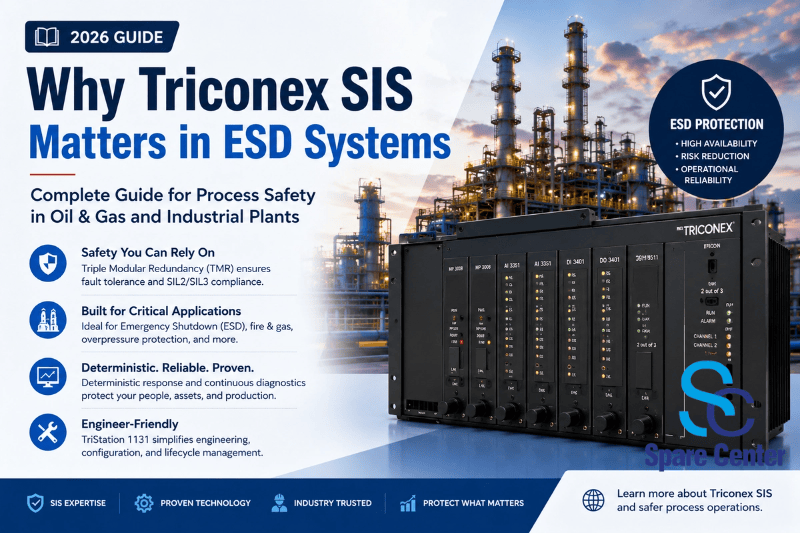
Unlike a standard PLC, a Triconex controller is based on Triple Modular Redundancy (TMR) architecture. That means:
2oo3 In real engineering terms, this is what allows a refinery or LNG plant to continue operating even if one channel fails silently. What many buyers overlook is this: SIS is not about “better control”—it is about guaranteed safe-state execution under failure conditions. |
|
Triconex PLC vs Triconex SIS system (real engineering difference)
Here’s the thing. Many procurement teams still ask: “Is Triconex just a PLC?”
Not exactly.
| Item | Standard PLC | Triconex SIS |
|---|---|---|
| Purpose | Process control | Safety shutdown |
| Risk level | Low/medium | High critical |
| Redundancy | Optional | Built-in TMR |
| Certification | Basic | SIL2 / SIL3 capable |
| Failure response | Restart or fault handling | Immediate safe trip |
In real commissioning work, this difference becomes obvious during FAT/SAT testing.
We’ve seen PLC logic pass simulation but fail real ESD timing requirements because response behavior is not fully deterministic under stress conditions.
That’s why Triconex systems are widely used in high-risk EPC projects.
Triconex applications in oil & gas industry
Triconex SIS is heavily used in high-hazard environments:
Offshore drilling platforms
LNG liquefaction facilities
Refinery distillation units
Gas compression stations
Petrochemical reactors
A typical scenario:
A compressor begins to surge → pressure rises rapidly → SIS detects abnormal trend → Triconex triggers emergency shutdown → isolation valves close within milliseconds.
In real plant operation, milliseconds can define whether equipment survives or fails.
One commissioning engineer once said:
“If the SIS reacts late, the logic doesn’t matter anymore.”
That statement is still valid in every modern safety system design.
How to program Triconex using TriStation (engineering reality)
Triconex systems are typically programmed using TriStation 1131 software.
Key characteristics:
Function block diagram logic (FBD style)
Safety-certified function libraries
Download protection mechanisms
Real-time diagnostics and monitoring
Typical workflow:
Define cause-and-effect safety matrix
Configure input voting logic
Map shutdown outputs (ESD actions)
Simulate trip conditions
Perform proof test validation
What many junior engineers struggle with is not coding—it’s thinking in safety logic philosophy.
For example:
PLC thinking: “If pressure > threshold, trigger output”
SIS thinking: “If pressure trend + sensor disagreement + delay logic → confirm safe shutdown”
This shift is critical in real plant engineering.
OEM / ODM engineering perspective (real manufacturing insight)
From an industrial manufacturing and OEM/ODM perspective, Triconex-class SIS platforms are typically built with:
Modular rack-based architecture
Triple-redundant controller design
Hot-swappable I/O modules
Industrial-grade conformal coating PCB
EMI-resistant enclosure structures
But in real procurement decisions, buyers care less about brochures and more about:
Long lifecycle availability (10–20 years)
Spare module compatibility across revisions
Firmware consistency and upgrade safety
DCS integration stability
Here’s the problem:
Many plants underestimate lifecycle management. We’ve seen shutdown delays simply because one I/O module revision is discontinued and no longer fully compatible with the installed system.
That’s not theoretical. That happens in real maintenance cycles.
Common field issues engineers actually face
Triconex SIS is highly reliable, but field issues still occur:
I/O channel mismatch after module replacement
TMR voting imbalance alarms
Communication delay with DCS systems
Grounding issues causing signal noise
Incorrect cause & effect configuration during upgrades
One real case in a chemical plant:
A maintenance team replaced a module during a shutdown window. Everything looked normal. The next day, intermittent false trips appeared.
Root cause: subtle firmware mismatch between redundant channels.
This is where SIS systems demand strict configuration discipline—not just technical knowledge.
Difference between PLC and Triconex SIS system (simple explanation)
If we simplify it:
PLC = runs the process
SIS = stops the process safely when something goes wrong
That’s the core difference.
A PLC is designed to tolerate minor logic uncertainty.
A Triconex SIS is not.
FAQ
1. What is Triconex used for?
Triconex is used for safety-critical applications such as emergency shutdown systems (ESD), process protection, and industrial safety automation in oil & gas and chemical plants.
2. Is Triconex a PLC or SIS system?
Triconex is primarily a Safety Instrumented System (SIS), not a standard PLC. It focuses on safety logic and fault-tolerant shutdown functions.
3. What is the difference between PLC and Triconex SIS?
A PLC is used for process control, while Triconex SIS is used for emergency shutdown and risk mitigation in hazardous environments.
4. How does Triconex redundancy work?
It uses Triple Modular Redundancy (TMR), where three independent processors execute logic simultaneously and vote on outputs.
5. How do you program Triconex using TriStation?
Programming is done in TriStation 1131 using function block logic, defining cause-and-effect matrices, voting logic, and safety interlocks.
6. Where is Triconex commonly used?
It is widely used in refineries, LNG plants, offshore platforms, and petrochemical processing facilities.
7. What is a Triconex controller?
It is the central processing unit of the SIS system responsible for executing safety logic and emergency shutdown commands.
Conclusion
Triconex SIS is not designed to optimize production—it is designed to protect it under failure conditions.
In real industrial environments, especially oil & gas and chemical processing, reliability is not a feature. It is a requirement.
Control systems keep operations running.
Safety systems decide whether the plant will safely exist tomorrow.
Recommendation
| Triconex | 3721 |
| Triconex | 3806E |
| Triconex | 8110 |
| Triconex | 3805H |
| Triconex | 3604E |
| Triconex | 4409 SMM |
| Triconex | 4351A |
| Triconex | 8311 |
| Triconex | SDO3411 S2 |
| Triconex | 7400219-040 |
| Triconex | DO 3401S2 |
| Triconex | AO 3481S2 |
| Triconex | DI 3301S2 |
| Triconex | AI 3351S2 |
| Triconex | AI3351 S2 |
| Triconex | DO3401 S2 |
| Triconex | DI3301 S2 |
| Triconex | AO3481 S2 |
| Triconex | CM3201 |
| Triconex | DO2401 HS2 7400219-040 |
| Triconex | SDO3411 |
| Triconex | 3501T |
If you want to more details,please contact me without hesitate.Email:sales@sparecenter.com
Triconex SIS Triconex SIS Triconex SIS Triconex SIS Triconex SIS Triconex SIS Triconex SIS Triconex SIS Triconex SIS Triconex SIS emergency shutdown system emergency shutdown system emergency shutdown system emergency shutdown system emergency shutdown system emergency shutdown system emergency shutdown system emergency shutdown system emergency shutdown system emergency shutdown system Triconex controller Triconex controller Triconex controller Triconex controller Triconex controller Triconex controller Triconex controller Triconex controller Triconex controller Triconex controller Triconex controller Triconex controller Triconex controller Triconex controller process safety system process safety system process safety system process safety system process safety system process safety system process safety system process safety system process safety system process safety system process safety system process safety system process safety system process safety system process safety system process safety system