

About Author
Written by Tina Jiang , Director of Spare Center
Tina Jiang has accumulated several years of experience in industrial sales and technical support, with a strong focus on automation systems and machine condition monitoring. In her daily work, she communicates closely with customers, prepares quotations, and recommends appropriate solutions for industrial control and monitoring needs. She also assists clients in sourcing replacement components, including hard-to-find or discontinued parts. Additionally, she coordinates with engineering teams and suppliers to ensure smooth project progress—helping maintain timely deliveries and competitive pricing so customers can minimize equipment downtime and keep operations running efficiently.
Introduction: It Works in Testing… Then Problems Show Up Later
A Siemens automation system is usually trusted from the start. Whether it’s Siemens SIMATIC S7-1200, S7-1500, or ET200 distributed I/O, most projects look completely fine during commissioning.
PLC goes online. I/O lights respond. Communication is stable. HMI looks normal.
At that point, everyone thinks the job is done.
But in real factories, that’s often not the end of the story. It’s more like the beginning.
Sometimes issues show up after a few hours. Sometimes after a few days of continuous running. And what makes it frustrating is that everything still looks correct on the surface.
Real Production Conditions Are Just Different In FAT or workshop testing, conditions are almost ideal. Clean power, short wiring, stable temperature, no heavy EMI. It’s controlled, predictable. But once the machine is installed on-site, things change quickly. We’ve seen systems that run perfectly in the supplier’s workshop, then start showing strange behavior at the customer factory. Same PLC, same program, same hardware. Nothing changed in theory—but the environment did. And honestly, this is where most people get surprised. EMI Problems That Don’t Show Up During TestingOne of the most common issues is electromagnetic noise. It sounds simple, but in real factories it’s everywhere. Drives switch. Motors start and stop. Power cables carry heavy load. And somewhere in the same cabinet, communication cables are running close to all of that. There was one packaging line project using SIMATIC S7-1200 PLC where the machine kept stopping randomly. No clear alarm. No consistent pattern. The PLC was replaced. Same problem. Cables were checked. Still nothing obvious. Later it turned out to be very simple: a PROFINET cable was routed parallel to a VFD output cable inside the cabinet. Once they separated the routing, the issue disappeared. No hardware change. Just wiring layout. This kind of thing happens more often than people think. | 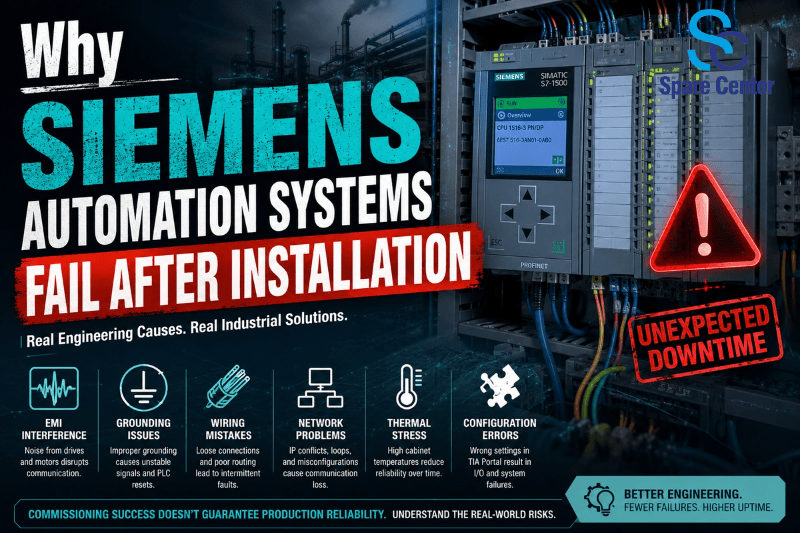 |
Grounding That Looks Fine but Isn’t
ET200 I/O Problems That Appear Only in Production
The Siemens ET200 distributed I/O system is usually reliable, but configuration mistakes tend to show up later—not during setup.
During commissioning, everything runs fine because system load is low.
Then production starts.
More signals. More traffic. More real-time communication.
And suddenly, random I/O drops appear.
In most cases we’ve seen, the cause is not hardware. It’s small configuration issues—station naming mistakes in TIA Portal, mismatched firmware versions, or duplicate PROFINET device names.
The frustrating part is that these problems don’t show up immediately. They appear only when the system is under pressure.
PLC CPU Overload (Not a Hardware Failure)
A lot of people assume the PLC is faulty when machines lag or freeze. But in compact systems like SIMATIC S7-1200, it’s often just overload.
Too many cyclic tasks.
Too much HMI polling.
Poorly structured logic.
We’ve seen machines pause for a second or two during peak operation, then recover by themselves. No alarm, no crash.
In reality, the PLC is just doing more work than expected. The system design is pushing it too hard.
Wiring Stress After Shipment
This is one of those issues that’s easy to underestimate.
Everything works during factory testing. Signals are stable, terminals are tight, nothing unusual.
Then the machine is shipped.
After installation, random faults appear.
One real case was a production line that passed all pre-delivery tests. But at the customer site, it kept stopping without explanation.
After checking almost everything, the issue turned out to be a slightly loose 24V terminal inside the cabinet. It survived testing, but vibration during transport changed it just enough to cause intermittent failure.
These are the kinds of problems that waste a lot of debugging time.
Communication Module CP Instability in Real Networks
A Siemens communication module CP depends heavily on how the network is built around it.
In real factories, networks are rarely clean. Devices get added later. Switches are replaced. IP addresses are reused. Sometimes documentation is not updated.
Then problems start appearing:
random disconnects
delayed signals
unstable SCADA communication
The tricky part is that these issues don’t happen all the time. They come and go, which makes them hard to trace.
Most of the time, it’s not the module itself—it’s the network structure around it.
Heat Inside the Cabinet (Often Ignored)
Temperature is another quiet factor.
On paper, everything is within spec. But inside a real control cabinet, conditions are different.
Fans get dusty. Airflow gets blocked. Ambient temperature goes up during peak production hours.
We’ve seen cabinets running hot enough that you wouldn’t expect long-term stability, even though nothing immediately fails.
The system keeps working, but slowly, reliability drops.
It doesn’t fail suddenly—it just becomes less stable over time.
FAQ: Siemens Automation Systems After Installation
Why does a Siemens automation system work during testing but fail later in production?
Because real factory environments introduce noise, vibration, and heat that don’t exist during commissioning.
Why does SIMATIC S7-1200 behave differently after installation?
Most issues come from grounding, wiring stress, or higher communication load in real operation.
Can EMI really affect Siemens PLC systems that much?
Yes. Poor cable routing near drives or motors can easily disturb communication signals.
Why does ET200 I/O fail only after production starts?
Because system load increases, and small configuration issues become visible under stress.
Is Siemens CPU module failure common in these cases?
Not really. Most of the time it’s system overload or design issues, not hardware damage.
Why does Siemens CP communication become unstable?
Usually due to network configuration issues or inconsistent switch setups.
How important is grounding in Siemens PLC systems?
Very important. Poor grounding is one of the most common hidden causes of instability.
Why do machines fail after shipping even if they passed testing?
Vibration and mechanical stress during transport often loosen connections slightly.
Conclusion
Siemens automation systems are not unreliable. In most real cases, the hardware is fine.
The difference appears when the system moves from testing into real production.
That’s when EMI, heat, wiring stress, and network structure all start interacting together.
And in practice, most “PLC problems” are not PLC problems at all. They are system integration issues that only become visible when the machine is actually doing real work.
Top-ranked Models
| LP1D65004BD | 131L9795 VLT FC-101P1K5T2E20H4 |
| HYDAC EDS 348-5-100-000 | 6ES73135BF030AB0 |
| S500B060R000 09080098 | 3441561000 1XK8249 |
| BA20160 | KVP3E01 |
| 10338-53000 | LEUZE ROTOSCAN RS4-4 50034195 |
| O444 R1S 60VOLTS 3394037 | PERCEPTRON 500-0243 |
| REO-444-R1 | PCD2M127 |
| 891.34.1998 891341998 7568305 0207 | DSA6MR50AQJYEU |
| BCL-32-R1-F-100 50036273 | SGDB10VD |
| BSH0702M01A1A 65032201-003 | 769828 5.0300.01.07.50.03 |
| 6XV14404BH80 | ABB DAM11000 2CMA139255R1000 |
| 380030 05091246 | STOBER 2290226 P421SGZ0080ME |
If you want to more details,please contact me without hesitate. Email:sales@sparecenter.com
#Steam Turbine Spare Parts Siemens automation system Siemens automation system Siemens automation system Siemens automation system Siemens automation system Siemens automation system Siemens automation system Siemens automation system Siemens automation system Siemens PLC Siemens PLC Siemens PLC Siemens PLC Siemens PLC Siemens PLC Siemens PLC Siemens PLC Siemens PLC Siemens PLC Siemens PLC Siemens PLC Siemens PLC Siemens PLC Siemens PLC Siemens PLC system system system Siemens PLC system Siemens PLC system Siemens PLC system Siemens PLC system Siemens PLC system Siemens PLC system Siemens PLC system Siemens PLC system Siemens PLC system Siemens PLC system Siemens PLC system Siemens PLC system Siemens PLC system Siemens PLC system SIMATIC S7-1200 SIMATIC S7-1200 SIMATIC S7-1200 SIMATIC S7-1200 SIMATIC S7-1200 SIMATIC S7-1200 SIMATIC S7-1200 SIMATIC S7-1200 SIMATIC S7-1200 SIMATIC S7-1200 SIMATIC S7-1200 SIMATIC S7-1200 SIMATIC S7-1200 SIMATIC S7-1200 SIMATIC S7-1200 SIMATIC S7-1200 SIMATIC S7-1200 SIMATIC S7-1200