

About Author
Written by Tina Jiang , Director of Spare Center
Tina Jiang has accumulated several years of experience in industrial sales and technical support, with a strong focus on automation systems and machine condition monitoring. In her daily work, she communicates closely with customers, prepares quotations, and recommends appropriate solutions for industrial control and monitoring needs. She also assists clients in sourcing replacement components, including hard-to-find or discontinued parts. Additionally, she coordinates with engineering teams and suppliers to ensure smooth project progress—helping maintain timely deliveries and competitive pricing so customers can minimize equipment downtime and keep operations running efficiently.
Introduction
A modern smart factory doesn’t just “use electricity” — it actively manages, distributes, and optimizes it in real time. That’s exactly where Schneider Electric comes into play.
A Schneider Electric-based system improves industrial stability, reduces downtime risk, and enables better integration between industrial automation solutions, electrical distribution systems, and smart energy systems.
In real projects, especially OEM/ODM industrial builds, we often see one pattern: companies don’t fail because they choose the wrong concept — they fail because they underestimate integration details between power, control, and monitoring layers.
Here’s the thing. Most “smart factory problems” are actually electrical architecture problems in disguise.
What Makes Schneider Electric Systems So Widely Used?If you look at global factories, data centers, and OEM panels, Schneider is everywhere. Not because it’s trendy, but because the ecosystem is built for engineering consistency. We’ve seen configurations built around:
This is where Schneider Electric products stand out — they’re not isolated devices, they are designed to connect. In many OEM cabinet projects (including industrial spare part sourcing platforms like sparecenter-type supply chains), engineers prefer Schneider components because replacement cycles and compatibility are predictable. Why Smart Factories Depend on Integration, Not Just HardwareHonestly, this is where many buyers get confused. On paper, two automation systems may look similar. Same voltage rating, same PLC spec, similar UPS capacity. But in actual factory deployment, things change quickly:
We’ve seen cases where a Schneider Electric UPS system for data centers reliability performs perfectly in lab testing, but triggers alarms in real factories due to harmonic distortion from legacy equipment. This is not a product failure — it’s an environment mismatch. | 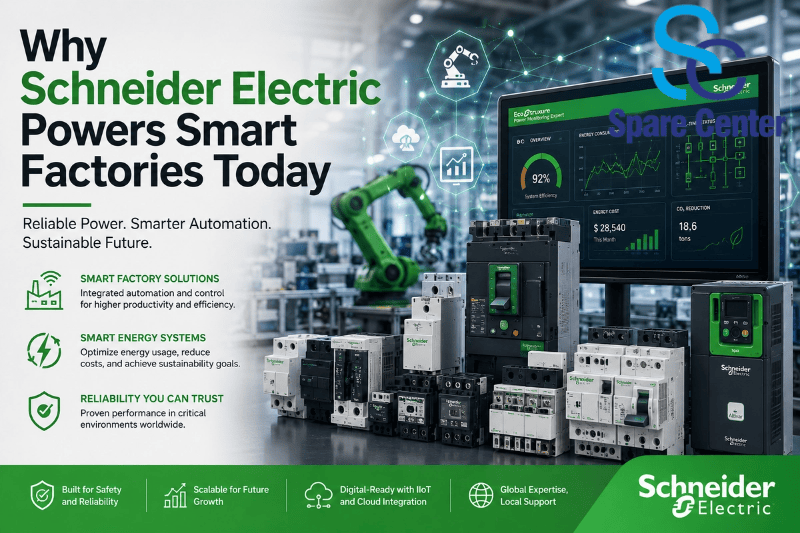 |
OEM/ODM Perspective: What Engineers Actually Care About
Digital Transformation Angle (What Most Articles Miss)
Everyone talks about “digital transformation”, but few explain what it means on the ground.
In real factories, Schneider Electric digital transformation in energy sector usually includes:
Real-time energy dashboards for production lines
Predictive maintenance alerts for breakers and drives
Cloud-based monitoring for multi-site factories
Integration with MES/SCADA systems
Here’s what many engineers overlook:
Digital transformation fails not because of software — but because sensor-level data is inaccurate due to poor wiring or unstable power infrastructure.
No data integrity = no smart factory.
This is based on field experience, not theory.
We’ve repeatedly seen:
Undersized UPS systems causing silent shutdowns
Over-optimized cabinet layouts with poor airflow
Mixing incompatible industrial communication protocols
Ignoring surge protection in high-humidity regions
One real example: a Southeast Asia packaging factory upgraded to smart PLC control, but failed to upgrade grounding systems. The result? Random PLC resets during peak humidity periods.
This is the kind of issue that never shows up in product datasheets.
How Schneider Electric Fits into Electrical Ecosystems
In practice, Schneider components are usually used as the backbone of:
Industrial automation lines
Electrical distribution systems in factories
Smart energy systems in commercial buildings
Data center power backup infrastructure
Because of this, engineers often treat Schneider not as a brand, but as an “infrastructure standard.”
FAQs
Q1: What are Schneider Electric products mainly used for?
They are used in industrial automation, electrical distribution, energy management, and smart factory systems.
Q2: Are Schneider Electric solutions suitable for smart factories?
Yes. They are widely used in smart factories due to strong integration between control, power, and monitoring systems.
Q3: Why do data centers prefer Schneider Electric UPS systems?
Because of high reliability, stable power output, and strong compatibility with monitoring systems.
Q4: Can Schneider Electric products be used in OEM/ODM cabinet manufacturing?
Yes. They are commonly used in OEM electrical cabinets due to modular design and global availability.
Q5: What industries use Schneider Electric solutions the most?
Manufacturing, energy, data centers, infrastructure, and building automation industries.
Q6: How does Schneider Electric support digital transformation?
Through IoT-enabled monitoring, predictive maintenance systems, and energy management platforms.
Q7: What is the advantage of Schneider Electric in industrial automation?
Stable communication protocols, scalable architecture, and strong ecosystem integration.
Q8: Are Schneider Electric systems expensive compared to alternatives?
They are usually mid-to-high range, but lower lifecycle cost due to reliability and reduced downtime.
Conclusion
In real industrial environments, success is rarely about choosing the cheapest component. It’s about system stability, integration logic, and long-term maintainability.
Schneider Electric has become widely adopted in industrial automation solutions and smart energy systems not because of marketing, but because it fits how real factories actually operate — messy, high-load, and continuously evolving.
And this is the key point many engineers eventually learn the hard way:
a smart factory is not built by adding smart devices — it’s built by designing a system that behaves predictably under stress.
Top-ranked Models
| LP1D65004BD | 131L9795 VLT FC-101P1K5T2E20H4 |
| HYDAC EDS 348-5-100-000 | 6ES73135BF030AB0 |
| S500B060R000 09080098 | 3441561000 1XK8249 |
| BA20160 | KVP3E01 |
| 10338-53000 | LEUZE ROTOSCAN RS4-4 50034195 |
| O444 R1S 60VOLTS 3394037 | PERCEPTRON 500-0243 |
| REO-444-R1 | PCD2M127 |
| 891.34.1998 891341998 7568305 0207 | DSA6MR50AQJYEU |
| BCL-32-R1-F-100 50036273 | SGDB10VD |
| BSH0702M01A1A 65032201-003 | 769828 5.0300.01.07.50.03 |
| 6XV14404BH80 | ABB DAM11000 2CMA139255R1000 |
| 380030 05091246 | STOBER 2290226 P421SGZ0080ME |
If you want to more details,please contact me without hesitate. Email:sales@sparecenter.com
#SteamTurbineSpare Schneider Electric products Schneider Electric products Schneider Electric products Schneider Electric products Schneider Electric products Schneider Electric products Schneider Electric products smart energy systems smart energy systems smart energy systems smart energy systems smart energy systems smart energy systems smart energy systems smart energy systems smart energy systems smart energy systems smart energy systems smart energy systems smart energy systems smart energy systems smart energy systems Schneider Electric UPS systems for data centers reliability Schneider Electric UPS systems for data centers reliability Schneider Electric UPS systems for data centers reliability Schneider Electric UPS systems for data centers reliability Schneider Electric UPS systems for data centers reliability