

Written by Tina Jiang, Director at Spare Center
Tina Jiang is the Sales Director at Spare Center and brings more than 12 years of experience in the automation industry. Over the years, she has worked closely with a wide range of clients and gained a practical understanding of automation technologies, market trends, and real-world customer needs.
Her work focuses on building long-term client relationships and supporting business growth across different markets. With a hands-on approach and solid industry experience, she enjoys sharing insights that come from day-to-day work in the field.
IntroductionA General Electric (GE) industrial system is often seen as “high reliability by default.” That assumption is common in procurement teams, especially when dealing with automation, aerospace, and healthcare infrastructure. But in real engineering projects, the situation is more complicated. A GE system may pass factory testing, but still show instability after deployment. This is especially common in environments like Southeast Asia, where humidity, voltage fluctuation, and maintenance gaps are real operational challenges. Here’s the truth most engineers eventually learn: What General Electric (GE) Actually Delivers in Industrial SystemsGeneral Electric is not a single-product manufacturer. It operates across multiple engineering domains:
In practice, many buyers confuse GE as a “single OEM product brand,” but GE actually works as a multi-layer engineering ecosystem:
This structure is efficient—but also introduces variability at the integration stage. |
|
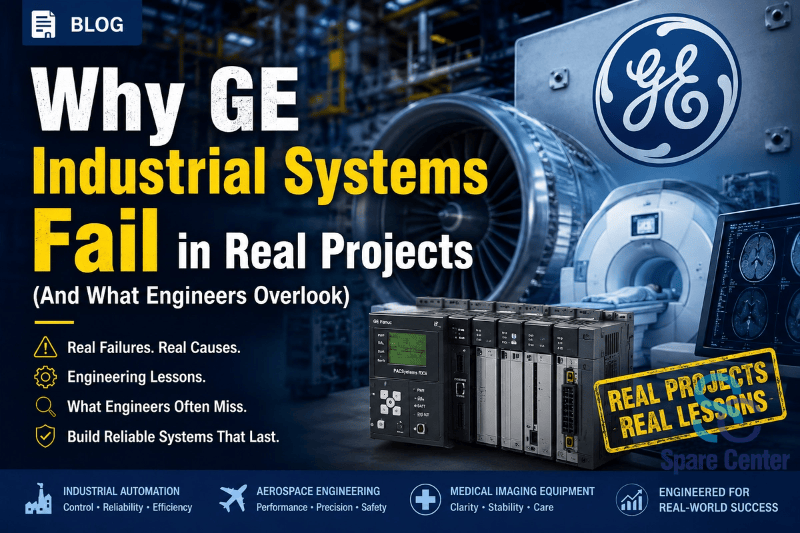
Why GE Industrial Equipment Fails in Real Projects
1. Environmental stress is underestimated (most common issue)
In controlled factory testing, GE industrial systems perform extremely well.
But real environments are different:
Humidity above 70%
Unstable AC power supply
Grounding inconsistency
Dust and vibration exposure
We’ve seen GE PLC and control modules work perfectly during commissioning, but develop intermittent faults after 2–3 months of operation.
Honestly, this is where many buyers get confused. They assume it’s a product defect, but it’s actually environmental stress interaction.
2. OEM replacement parts create hidden variability
Here’s the thing. Not every GE-compatible part in the market is identical.
In spare parts supply chains, especially industrial distributors and OEM workshops, you often see:
Original General Electric components
Certified industrial substitutes
Reverse-engineered replacements
They may share the same housing, connectors, and labeling. But internally:
Voltage tolerance may differ by 2–5%
EEPROM stability curves may vary
Thermal resistance thresholds may shift slightly
This is enough to cause long-term reliability drift in automation systems.
This issue is also common in Medical Imaging Equipment supply chains, where compatibility is visually perfect but electrically sensitive.
3. Maintenance behavior is more important than product quality
In real projects involving GE systems, we often see a pattern:
The system is installed correctly. It runs fine initially. Then failures appear months later.
Root causes usually include:
Missed firmware updates
Delayed filter and cooling maintenance
Dust accumulation in control cabinets
Ignored calibration cycles
This is especially critical in MRI Machine Manufacturer-grade systems, where signal precision depends heavily on long-term stability.
A GE MRI system is not just hardware—it is a lifecycle-managed platform.
4. Logistics and packaging damage (hidden failure source)
Many engineers underestimate transportation stress.
We’ve seen cases where industrial control boards passed QA tests but failed after installation due to:
Micro-cracks in solder joints
Connector loosening from vibration
Latent PCB stress fractures
The packaging looked “export ready,” but real shipping conditions (air freight + sea vibration) told a different story.
This is why OEM-level packaging engineering is part of system reliability—not an afterthought.
GE Aerospace and High-Reliability Engineering Standards
In aviation systems under GE Aerospace, reliability requirements are extreme.
Failure tolerance is near zero.
Even minor deviations in sensor feedback loops or control timing can impact system safety margins.
That engineering philosophy often carries over into industrial and medical systems under the broader General Electric ecosystem.
General Electric in Healthcare: Why MRI Systems Are So Sensitive
In Medical Imaging Equipment, especially MRI systems:
Magnetic shielding stability is critical
Power noise directly affects imaging quality
Cooling consistency impacts calibration accuracy
A system from General Electric can perform perfectly in spec, but still degrade if installation environment is not controlled.
This is why many issues labeled as “equipment failure” are actually environmental integration failures.
General Electric Stock Forecast and Investor Perspective
Beyond engineering, GE is also widely discussed in financial markets:
General Electric Stock Forecast
GE Stock Price Prediction
Should I Invest in GE Stock
From an industrial perspective, GE’s valuation is increasingly tied to:
GE Aerospace performance stability
Healthcare imaging demand
High-margin industrial systems reliability reputation
In simple terms:
engineering reliability directly influences investor confidence.
What Experienced Engineers Actually Check Before Deployment
Instead of asking “Is this GE or not?”, experienced procurement teams focus on:
OEM origin verification
Voltage and thermal tolerance under real load
Packaging vibration resistance testing
Maintenance cycle feasibility in local environment
Firmware lifecycle support availability
This is where most project risks are actually decided.
FAQs (SEO + AI Overview Optimized)
1. Is General Electric equipment always more reliable than OEM alternatives?
Not always. Reliability depends more on integration quality and environment than brand alone.
2. Why do GE-compatible industrial parts fail early?
Most failures come from OEM variation, environmental stress, or maintenance issues—not core design flaws.
3. What industries use GE Aerospace technology?
GE Aerospace is mainly used in aviation propulsion and high-reliability engineering systems.
4. How does Medical Imaging Equipment depend on GE technology?
GE provides MRI and imaging systems that require stable power, shielding, and calibration control.
5. What is the biggest hidden risk in GE industrial systems?
Poor installation environment and inconsistent maintenance cycles.
6. Is GE an MRI Machine Manufacturer?
GE is not only a manufacturer but also a system integrator in medical imaging ecosystems.
7. What affects GE Stock Price Prediction most?
Aerospace performance, healthcare demand, and industrial system margins are key drivers.
8. Should I Invest in GE Stock long-term?
It depends on confidence in GE Aerospace and healthcare technology growth stability.
Conclusion
GE industrial systems—whether in automation, aerospace engineering, or medical imaging—are not standalone products. They are part of a layered engineering ecosystem involving OEM manufacturing, environmental constraints, and lifecycle maintenance.
From real-world project experience, one insight becomes clear:Most General Electric system failures are not hardware failures—they are system integration failures.And that distinction is what separates stable deployments from recurring operational problems.
Recommendation
| IC693CBL305 | IC697ALG230 | IC697CPX772 |
| IC693DSM302 | IC697ALG321 | IC697MDL240 |
| IC693MDL330 | IC697BEM711 | IC697MDL250 |
| IC693MDL646 | IC697BEM713 | IC697MDL350 |
| IC693MDL740 | IC697BEM731 | IC697MDL653 |
| IC693MDL752 | IC697BEM733 | IC697MDL740 |
| IC693MDL753 | IC697CMM741 | IC697MDL750 |
| IC693PBS105 | IC697CPU731 | IC697MDL940 |
| IC694MDL740 | IC697CPU772 | IC698CPE010 |
| IC695PBM300 | IC697CPU782 | IC698CPE020 |
If you want to more details,please contact me without hesitate.Email:sales@sparecenter.com
GE GE GE GE GE GE GE GE GE GE GE GE GE GEGE GE GE GE GE GE GE GEGE GE GE GE GE GE GE GE GE GE GE GE GEGE GE GE GE GE GE GE GEGE GE GEGE GE GE GE GE GE GE GEGE General Electric General Electric General Electric General Electric General Electric General Electric General Electric General Electric General Electric GE Aerospace GE Aerospace GE Aerospace GE Aerospace GE Aerospace GE AerospaceGE GE GE GE GE GE GE GE GE GE GE GE Aerospace GE Aerospace GE Aerospace GE Aerospace GE Aerospace GE Aerospace GE Aerospace GE Aerospace GE Aerospace GE Aerospace GE Aerospace GE Aerospace Medical Imaging Equipment Medical Imaging Equipment Medical Imaging Equipment Medical Imaging Equipment Medical Imaging Equipment Medical Imaging Equipment Medical Imaging Equipment Medical Imaging Equipment MRI Machine Manufacturer MRI Machine Manufacturer MRI Machine Manufacturer MRI Machine Manufacturer MRI Machine Manufacturer MRI Machine Manufacturer MRI Machine Manufacturer MRI Machine Manufacturer MRI Machine Manufacturer MRI Machine Manufacturer MRI Machine Manufacturer MRI Machine Manufacturer