

Written by Tina Jiang, Director at Spare Center
Tina Jiang is the Sales Director at Spare Center and brings more than 12 years of experience in the automation industry. Over the years, she has worked closely with a wide range of clients and gained a practical understanding of automation technologies, market trends, and real-world customer needs.
Her work focuses on building long-term client relationships and supporting business growth across different markets. With a hands-on approach and solid industry experience, she enjoys sharing insights that come from day-to-day work in the field.
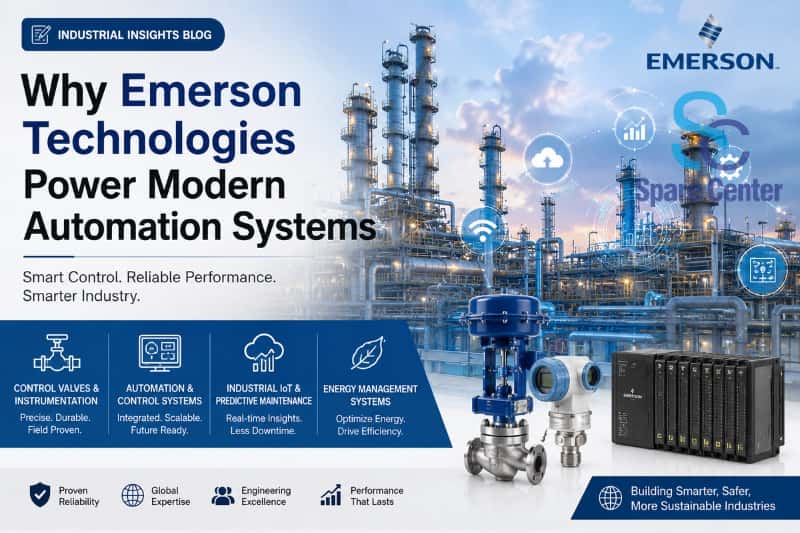
IntroductionA modern industrial automation system is no longer just about machines working faster. It’s about control, data, prediction, and energy efficiency working together in real time. In simple terms: if your plant still relies on isolated control loops, you’re already behind. A lot of engineers on Quora and Reddit ask a similar question: “Why is Emerson still considered a top-tier automation company in chemical and energy industries?” The short answer is this—because real industrial environments are messy, and only a few companies design systems that survive that reality. That’s where Emerson company stands out. We’ve seen many factories where systems look fine on paper but struggle under vibration, temperature fluctuation, or long-term calibration drift. Emerson’s strength is not just in hardware—it’s in how control logic, instrumentation, and field devices actually behave inside real plants. What Emerson Actually Does in Industrial SystemsLet’s be clear first. Emerson is not just a “hardware vendor.” It operates more like an automation engineering company that integrates: control valves and instrumentation distributed control systems (DCS) energy management systems industrial software + IIoT platforms When people search for Emerson control systems for chemical processing plants, what they usually mean is this: And this is exactly where Emerson systems are designed to help. In real projects, control stability is often more important than raw precision. A valve that is 99% accurate in lab conditions but unstable in field conditions is basically useless. |
|
Why Emerson Systems Are Widely Used in Heavy Industry
Here’s the thing. Most automation failures don’t come from “bad engineering design.” They come from integration gaps.
We’ve seen this pattern repeatedly in industrial plants:
Sensors calibrated correctly but drift under heat cycles
Control valves respond well initially but degrade after months of vibration
Maintenance teams lack predictive warning signals
Operators rely too much on manual overrides
This is exactly why Emerson technologies are often chosen in oil & gas, power generation, and chemical processing environments.
Their systems focus heavily on:
real-time process stability
predictive maintenance
field-device diagnostics
energy efficiency optimization
And this connects directly with Emerson industrial IoT platforms for predictive maintenance, which is becoming a major decision factor for modern factories.
Control Valves and Instrumentation: The Real Backbone
If there’s one area where Emerson has deep engineering reputation, it’s control valves and instrumentation.
In real production environments, valves are not just “flow controllers.” They are dynamic mechanical systems exposed to:
corrosive media
pressure cycling
thermal expansion
continuous actuation wear
Honestly, this is where many buyers get confused. They compare specs like Cv value or pressure rating, but ignore lifecycle behavior.
A common field issue we’ve seen:
A valve performs perfectly during commissioning, but after 6–8 months of continuous operation, response delay increases due to actuator wear and scaling inside the seat.
Emerson’s approach typically integrates diagnostics at the device level, allowing engineers to detect performance degradation early instead of waiting for failure.
OEM/ODM and Engineering Adaptation Perspective
From an OEM/ODM engineering standpoint, industrial buyers care about more than branding. They care about:
compatibility with existing DCS systems
ease of integration with plant protocols
customization for process-specific conditions
packaging and industrial-grade protection
We’ve seen cases where two systems look identical on datasheets, but installation outcomes differ drastically due to wiring standards, enclosure protection levels, or signal noise handling.
This is where engineering maturity matters more than marketing.
Emerson in Smart Manufacturing and Industry 4.0
Modern factories are shifting toward connected systems. The keyword here is visibility.
Manufacturers now ask:
Can I see process performance remotely?
Can I predict equipment failure before shutdown?
Can I optimize energy consumption dynamically?
This is exactly what how Emerson supports smart manufacturing and Industry 4.0 is about.
Instead of just controlling machines, systems now:
collect real-time operational data
analyze degradation patterns
trigger maintenance alerts
optimize energy usage dynamically
In practice, this reduces unplanned downtime more than traditional preventive maintenance ever could.
Real-World Engineering Insight (Not Just Theory)
We’ve seen a recurring pattern in factories across Southeast Asia:
Many plants invest heavily in sensors but neglect system-level integration.
For example:
high-end flow meters installed
but poor signal filtering causes noisy control loops
operators end up overriding automation manually
In contrast, well-integrated Emerson-based systems tend to focus on stability first, not just measurement accuracy.
This difference becomes obvious after 6–12 months of operation.
FAQ (Frequently Asked Questions)
1. What industries use Emerson technologies most?
Oil & gas, chemical processing, power generation, water treatment, and large-scale manufacturing plants.
2. What are Emerson control valves used for?
They regulate flow, pressure, and temperature in industrial processes, especially where stability and safety are critical.
3. How does Emerson support predictive maintenance?
Through industrial IoT platforms that monitor equipment health, detect anomalies, and forecast failure risks before breakdowns occur.
4. Is Emerson suitable for smart manufacturing systems?
Yes. Emerson systems are widely used in Industry 4.0 environments due to strong integration between hardware, software, and real-time analytics.
5. What makes Emerson different from other automation companies?
The key difference is system reliability under real industrial stress conditions, not just lab specifications.
6. Can Emerson systems integrate with existing factory equipment?
Yes, most Emerson automation platforms are designed for compatibility with legacy systems and multi-vendor environments.
7. What is included in Emerson instrumentation solutions?
Typically sensors, transmitters, control valves, and monitoring systems used for process automation and control.
Conclusion
Industrial automation is not just about installing advanced equipment. It’s about building systems that continue to perform under stress, over time, and across unpredictable operating conditions.
Emerson company has built its reputation by focusing exactly on that gap—turning complex industrial environments into controllable, measurable, and increasingly predictable systems.
In real engineering projects, that difference is what separates a system that “works in commissioning” from a system that “works for years.”
Recommendation
| PR6426/010-030 CON021/916-160 | KC3011X1-BA1 12P6749X062 | PR6424/000-040 CON021 |
| KJ3221X1-BA1 12P2531X102 VE4005S2B1 | KC3020X1-BA1 12P6732X092 | PR9350/04 |
| KJ3102X1-BB1 12P1864X032 | KC4011X1-BM1 12P6884X052 | MMS6220 |
| KJ3102X1-BE1 12P2703X022 VE4013S2B1 | KC4011X1-BQ1 12P6892X042 | KJ2231X1-EA1 |
| KJ3208X1-BA2 13P0105X012 | KJ2201X1-BA1 12P3162X202 SLS1508 | KJ3001X1-BC1 12P0551X132 VE4001S3T1B1 |
| PR6424/002-130 CON021 | KJ2003X1-BB1 12P3439X022 VE3006 | KJ4001X1-BA2 12P1562X012 VE3051CO |
| PR9268/201-100 | PR6423/002-131 CON021 | KL4201X1-BA1 |
| KJ2005X1-MQ2 13P0072X082 VE3008 | PR6424/013-110 CON021 | KJ3001X1-BA1 1290549X152 |
| KJ2221X1-BA1 12P3232X132 VS6002 | PR6423/10R-141 CON031 | KJ3001X1-BG1 12P0557X162 |
| KJ2003X1-BB1 12P3439X032 VE3006 | KJ2005X1-MQ1 12P6381X022 VE3008 | KJ3209X1-BA1 12P3905X012 VE4002S2T1B1 |
If you want to more details,please contact me without hesitate.Email:sales@sparecenter.com
Emerson company Emerson company Emerson company Emerson company Emerson company Emerson company Emerson company Emerson company Emerson company Emerson company Emerson company Emerson company Emerson company Emerson company Emerson company Emerson company Emerson company Emerson company Emerson company Emerson company Emerson company Emerson company Emerson technologies Emerson technologies Emerson technologies Emerson technologies Emerson technologies Emerson technologies Emerson technologies Emerson technologies Emerson technologies Emerson technologies Emerson technologies Emerson technologies Emerson technologies
control valves and instrumentation control valves and instrumentation control valves and instrumentation control valves and instrumentation control valves and instrumentation control valves and instrumentation control valves and instrumentation automation engineering company automation engineering company automation engineering company automation engineering company automation engineering company automation engineering company automation engineering company automation engineering company automation engineering company