

Written by Tina Jiang, Director at Spare Center
Tina Jiang is the Sales Director at Spare Center and brings more than 12 years of experience in the automation industry. Over the years, she has worked closely with a wide range of clients and gained a practical understanding of automation technologies, market trends, and real-world customer needs.
Her work focuses on building long-term client relationships and supporting business growth across different markets. With a hands-on approach and solid industry experience, she enjoys sharing insights that come from day-to-day work in the field.
IntroductionA Bently Nevada vibration sensor system is not just a measurement tool—it is the early warning layer of rotating machinery safety. In power plants, refineries, and compressor stations, even a 10–20 micron shaft deviation can signal the beginning of catastrophic failure. A lot of engineers new to condition monitoring ask the same question on Quora and Reddit:
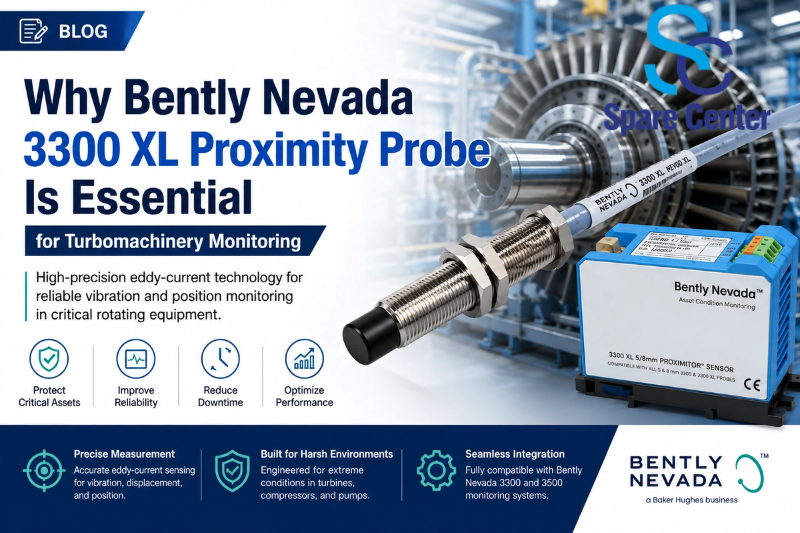
Honestly, this is where many buyers get confused. On paper, everything looks stable. In real operation, however, installation geometry, probe gap voltage, cable routing, and even grounding quality can completely change the signal behavior. We’ve seen this repeatedly in field commissioning—especially in older turbine retrofits where original wiring practices were not followed strictly. What Is a Bently Nevada 3300 XL Proximity Probe System?A Bently Nevada 3300 XL probe system is an eddy-current based displacement measurement solution used for:
The system is typically composed of:
The probe does not touch the shaft. Instead, it measures distance using an electromagnetic field, converting gap changes into voltage signals. Typical output behavior:
|
|
Why the 3300 XL Series Is Still Widely Used Today
Many engineers ask:
“Why are we still using Bently Nevada 3300 XL when newer systems exist?”
Here’s the thing. Most smart upgrades fail not because the new system is better, but because integration becomes complicated.
The 3300 XL platform survives because:
It is backward compatible with legacy 3500 system architecture
It integrates easily with Bently Nevada 3500/22M and 3500/50M modules
Maintenance teams already understand its signal behavior
Spare parts and OEM probes are widely available
In real projects, simplicity beats innovation when downtime costs $50,000 per hour.
Engineering Insight: Where Most Installation Problems Happen
We’ve seen a pattern across many field failures:
1. Incorrect probe gap voltage setup
Many engineers assume factory calibration is enough. It’s not.
If the Bently Nevada probe gap voltage is not set correctly:
Signal saturation happens
False vibration alarms appear
Shaft orbit plots become unstable
2. Cable routing mistakes
In one refinery project in Southeast Asia, vibration spikes were traced back to:
Probe cable running parallel to high-voltage motor lines
Poor shielding grounding
After rerouting, the signal stabilized immediately.
3. Misalignment during mounting
Even a 0.1 mm misalignment can distort eddy current linearity.
This is something many OEM contractors underestimate during installation.
OEM Manufacturing & System Integration Perspective
From an OEM perspective, Bently Nevada systems are not just sensors—they are precision calibration ecosystems.
A proper supply chain includes:
Original Bently Nevada probe (3300 XL series)
Matching extension cable with impedance control
Proximitor sensor (e.g., 330180 series modules)
We’ve noticed that many industrial buyers try to mix compatible parts from different sources. That often leads to signal instability during thermal cycling.
In long-term operation, especially in turbine environments, even small impedance mismatches can amplify noise.
Real Field Case: Compressor Vibration Instability
A petrochemical plant reported unstable readings on a gas compressor equipped with a Bently Nevada vibration sensor system.
Symptoms:
Random vibration spikes
Axial position drift
Alarm triggering without mechanical cause
After inspection, the root cause was not mechanical failure.
It was:
Aging extension cable insulation
Slight corrosion at connector interface
After replacing the probe chain with a full matched system (probe + cable + Proximitor), the signal returned to stable baseline.
This is where things get tricky—because the machine was actually healthy, but the monitoring system was not.
Key Technical Parameters (3300 XL Probe System)
Measurement type: Eddy-current displacement sensing
Output: Analog voltage proportional to shaft gap
Typical system sensitivity: ~7.87 V/mm
Operating temperature range: -40°C to +120°C (system dependent)
Application: Turbomachinery condition monitoring
Compatible modules: Bently Nevada 3500/22M, 3500/50M
FAQ – Bently Nevada 3300 XL System
Q1: What is the main function of a Bently Nevada 3300 XL probe?
It measures shaft displacement and vibration using eddy-current technology for real-time machinery protection.
Q2: Why does a Bently Nevada vibration sensor show unstable readings?
Most cases are caused by installation issues, grounding problems, or cable degradation rather than sensor failure.
Q3: What is the role of a Bently Nevada Proximitor sensor?
It converts raw probe signals into calibrated voltage outputs for monitoring systems.
Q4: Can 3300 XL probes work with 3500 series systems?
Yes, many setups integrate with Bently Nevada 3500/22M and 3500/50M modules depending on configuration.
Q5: What causes incorrect Bently Nevada probe gap voltage?
Improper calibration, incorrect mounting distance, or signal chain mismatch.
Q6: How often should Bently Nevada probes be replaced?
In harsh turbine environments, typical lifecycle is 5–10 years depending on conditions.
Q7: What is the most common failure point in probe systems?
Not the probe itself—but connectors and extension cables.
Industry Insight: What Buyers Often Overlook
Many procurement teams focus only on model numbers like:
330101 series probes
330180 Proximitor modules
But in real engineering practice, system compatibility matters more than individual component specs.
We’ve seen projects fail simply because:
Cable impedance mismatch was ignored
Non-OEM replacement probes were used
Installation torque was not standardized
This is not obvious on datasheets, but it shows up during commissioning.
Conclusion
The Bently Nevada condition monitoring ecosystem remains one of the most trusted industrial vibration monitoring solutions in the world. Its strength is not only in sensor accuracy, but in system-level integration across probes, cables, and Proximitor modules.
In real-world industrial environments, success is not about choosing the most advanced sensor—it is about maintaining signal integrity across the entire measurement chain.
If there is one takeaway from field experience, it is this:A stable Bently Nevada vibration sensor system is never just a product—it is a properly engineered measurement architecture.
Recommendation
| 330104-00-08-10-02-CN | 330104-00-06-10-02-00 | 330104-00-04-10-02-05 |
| 330104-00-08-10-02-00 | 330104-00-06-05-02-00 | 330104-00-04-10-02-00 |
| 330104-00-08-10-01-05 | 330104-00-05-50-02-00 | 330104-00-04-05-02-00 |
| 330104-00-08-10-01-00 | 330104-00-05-10-02-CN | 330104-00-03-05-02-00 |
| 330104-00-08-05-02-05 | 330104-00-05-10-02-00 | 330103-15-23-05-02-CN |
| 330104-00-08-05-02-00 | 330104-00-05-05-02-CN | 330103-13-23-05-02-00 |
| 330104-00-07-90-02-00 | 330104-00-05-05-02-05 | 330103-12-25-10-02-00 |
| 330104-00-07-10-02-CN | 330104-00-05-05-02-00 | 330103-12-25-10-01-00 |
| 330104-00-07-05-02-00 | 330104-00-04-50-11-00 | 330103-11-19-10-02-00 |
| 330104-00-06-10-02-CN | 330104-00-04-10-02-CN | 330103-10-20-10-02-00 |
If you want to more details,please contact me without hesitate.Email:sales@sparecenter.com
Bently Nevada 3300 XL probe Bently Nevada 3300 XL probe Bently Nevada 3300 XL probe Bently Nevada 3300 XL probe Bently Nevada 3300 XL probe Bently Nevada 3300 XL probe Bently Nevada 3300 XL probe Bently Nevada 3300 XL probe Bently Nevada 3300 XL probe Bently Nevada 3300 XL probe Bently Nevada vibration sensor Bently Nevada vibration sensor Bently Nevada vibration sensor Bently Nevada vibration sensor Bently Nevada vibration sensor Bently Nevada vibration sensor Bently Nevada probe gap voltage Bently Nevada probe gap voltage Bently Nevada probe gap voltage Bently Nevada probe gap voltage Bently Nevada probe gap voltage Bently Nevada probe gap voltage Bently Nevada probe gap voltage Bently Nevada probe gap voltage Bently Nevada 3500/22M Bently Nevada 3500/22M Bently Nevada 3500/22M Bently Nevada 3500/22M Bently Nevada 3500/22M Bently Nevada 3500/22M Bently Nevada 3500/22M Bently Nevada 3500/22M Bently Nevada 3500/22M Bently Nevada 3500/22M Bently Nevada 3500/22M