

Written by Tina Jiang, Director at Spare Center
Tina Jiang is the Sales Director at Spare Center and brings more than 12 years of experience in the automation industry. Over the years, she has worked closely with a wide range of clients and gained a practical understanding of automation technologies, market trends, and real-world customer needs.
Her work focuses on building long-term client relationships and supporting business growth across different markets. With a hands-on approach and solid industry experience, she enjoys sharing insights that come from day-to-day work in the field.
IntroductionIn industrial automation, an Allen-Bradley PLC is often treated like a “set-and-forget” controller. In reality, that assumption is exactly where many OEM projects start to fail. A PLC system is not just hardware. It’s a combination of programming logic, communication stability, field wiring quality, and long-term maintenance strategy. When one of these layers is weak, downtime shows up—sometimes months after commissioning. We’ve seen this pattern repeatedly in retrofit projects involving Allen-Bradley systems under Rockwell Automation ecosystems, especially when factories migrate from legacy RSLogix 500 setups to newer GuardLogix architectures. Here’s the thing: most failures are not “PLC failures.” They are integration failures. What an Allen-Bradley PLC Actually Does in OEM SystemsA modern OEM machine using Allen-Bradley control typically includes:
In safety-critical applications, GuardLogix safety PLC is used to handle dual-channel logic, emergency stops, and interlock systems. Motion-heavy machines often rely on Kinetix motion control for precise positioning. On paper, this looks solid. In real factories, things get messy fast. |
|
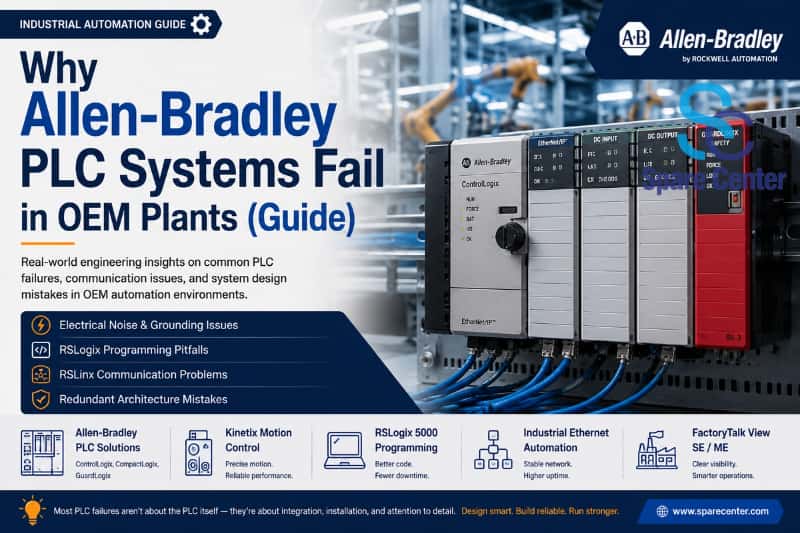
Why PLC Systems Fail in Real OEM Environments
1. Electrical noise and grounding issues (most ignored problem)
Honestly, this is where many buyers get confused.
A PLC cabinet may pass FAT testing in a clean environment, but once installed near VFDs or welding machines, noise interference starts corrupting signals.
We’ve seen cases where:
Ethernet packets drop intermittently
Analog signals drift unexpectedly
Safety inputs trigger false alarms
Here’s the problem: grounding is treated as “installation detail,” but it is actually system stability.
2. RSLogix programming legacy gaps
Many OEM factories still run mixed environments:
RSLogix 5000 for modern controllers
RSLogix 500 for older SLC/MicroLogix systems
This hybrid setup often leads to logic mismatch during upgrades.
We once reviewed a packaging line where a simple timer instruction behaved differently after migration. The engineer assumed hardware fault. It was actually ladder logic translation inconsistency.
This is where things get tricky.
3. Communication driver misconfiguration
Industrial communication is often underestimated.
Using RSLinx incorrectly can result in:
Tag browsing delays
HMI disconnections
False “device offline” alarms
In industrial Ethernet automation environments, even small IP conflicts can cascade into full line stoppage.
4. Redundant architecture not truly redundant
Many OEM buyers request redundant PLC systems, but do not design redundancy correctly.
A real redundant PLC architecture requires:
Synchronized scan cycles
Dual power supply isolation
Network redundancy (Device Level Ring or star topology fallback)
Without these, redundancy exists only on paper.
5. OEM/ODM manufacturing variation issues
Here’s something rarely discussed.
Two PLC cabinets may look identical, but OEM/ODM variations change everything:
Wire routing differences
Terminal block substitution
Fan airflow direction changes
Different surge protection modules
We’ve seen a simple cabinet redesign cause overheating issues after 3–4 hours of runtime under load.
This is common in industrial spare part supply chains like those listed on spare parts platforms (for example Allen-Bradley compatible replacement ecosystems), where OEM substitutions are frequent.
Real Engineering Case (Packaging Line Downtime)
A Southeast Asia beverage plant upgraded its filling line using GuardLogix safety PLC and Kinetix servo system.
Problem:
Random machine stop every 6–8 hours
No fault code from PLC
Drives showed “communication timeout”
Root cause:
Shield grounding was connected at both ends of the cable (creating ground loop noise). The PLC was fine. The network was unstable.
Fix:
Single-point grounding + rerouted Ethernet away from high-voltage VFD lines.
Downtime dropped by 92%.
EEAT Engineering Insight (What Most People Miss)
We’ve noticed a pattern across OEM factories:
Many engineers focus too much on PLC programming logic and ignore physical installation discipline.
But in real plants:
30% problem = programming
40% problem = electrical noise / wiring
20% problem = communication network
10% problem = actual hardware defect
This is not theory. This is field observation across multiple retrofit projects.
How to Improve Reliability (Practical OEM Checklist)
Separate power and signal wiring physically
Use shield grounding strategy (single-point only)
Validate RSLogix tag mapping before commissioning
Lock firmware versions across PLC + HMI + drives
Test EtherNet/IP under load, not just idle state
Document OEM cabinet layout changes strictly
Small details decide uptime.
FAQ (5–8 Questions)
1. Why does Allen-Bradley PLC randomly stop working?
Most cases are not PLC failure but network noise, grounding issues, or communication timeouts.
2. What is the difference between RSLogix 5000 and RSLogix 500?
RSLogix 5000 is for Logix-based systems (ControlLogix/CompactLogix), while RSLogix 500 is for older SLC/MicroLogix controllers.
3. Is GuardLogix necessary for all machines?
No. It is required only for safety-rated applications such as emergency stop systems or safety interlocks.
4. Why does Ethernet/IP fail in industrial environments?
Main reasons include IP conflicts, cable shielding issues, and improper network topology design.
5. What causes Kinetix servo alarms?
Common causes include feedback noise, drive tuning issues, or communication interruption with PLC.
6. Can legacy PLC systems be upgraded easily?
Not always. Legacy systems often require logic rewriting and hardware compatibility checks.
7. What is FactoryTalk View SE / ME used for?
It is used for HMI visualization—SE for networked systems and ME for standalone machines.
8. How important is redundant PLC architecture?
It is critical in continuous production lines where downtime cost is high, but only if properly implemented.
Conclusion
Allen-Bradley PLC systems are extremely robust, but they are not immune to real-world engineering conditions.
Most failures we see are not caused by the controller itself, but by integration gaps between programming, wiring, network design, and OEM manufacturing variations.
In real factory environments, reliability is not about choosing the “best PLC brand.” It is about designing a system where every layer—hardware, software, and installation—works together without assumptions.
Recommendation
| 1746-ITV16 | 1747-L531 | 1756-EN2TR |
| 1746-OV32 | 1747-L543P | 1756-EN2TXT |
| 1746-OW4 | 1747OC-EBCBA | 1756-EN3TR |
| 1746-OX8 | 1747-OCPCM2 | 1756-ENET |
| 1746SC-IA8I | 1747-OCVGA1 | 1756-EWEB |
| 1746SC-NO8I | 1747-SCNR | 1756-IH16I |
| 1747-ACN15 | 1756-CN2RXT | 1756-IT6I2 |
| 1747-AICR | 1756-CNBR | 1756-IV16 |
| 1747-DCM | 1756-DMA31 | 1756-L1M2 |
| 1747-L20C | 1756-DMD30 | 1756-L63S |
If you want to more details,please contact me without hesitate.Email:sales@sparecenter.com
Allen-Bradley PLC Allen-Bradley PLC Allen-Bradley PLC Allen-Bradley PLC Allen-Bradley PLC Allen-Bradley PLC Allen-Bradley PLC Allen-Bradley PLC Allen-Bradley PLC Allen-Bradley PLC Allen-Bradley PLC Allen-Bradley PLC Allen-Bradley PLC Allen-Bradley PLC FactoryTalk View SE / ME FactoryTalk View SE / ME FactoryTalk View SE / ME FactoryTalk View SE / ME FactoryTalk View SE / ME FactoryTalk View SE / ME FactoryTalk View SE / ME FactoryTalk View SE / ME FactoryTalk View SE / ME Industrial Ethernet automation Industrial Ethernet automation Industrial Ethernet automation Industrial Ethernet automation Industrial Ethernet automation Industrial Ethernet automation Industrial Ethernet automation Industrial Ethernet automation Industrial Ethernet automation Redundant PLC architecture Redundant PLC architecture Redundant PLC architecture Redundant PLC architecture Redundant PLC architecture Redundant PLC architecture Redundant PLC architecture Redundant PLC architecture Redundant Redundant PLC architecture