

Written by Tina Jiang, Director at Spare Center
Tina Jiang is the Sales Director at Spare Center and brings more than 12 years of experience in the automation industry. Over the years, she has worked closely with a wide range of clients and gained a practical understanding of automation technologies, market trends, and real-world customer needs.
Her work focuses on building long-term client relationships and supporting business growth across different markets. With a hands-on approach and solid industry experience, she enjoys sharing insights that come from day-to-day work in the field.
ABB industrial robots don’t usually “just fail”. In most cases, what looks like a sudden breakdown is actually the result of small issues building up over time — inside controllers, power systems, or even something as simple as cooling and wiring that nobody checked for months. If you’ve worked in a factory long enough, you’ve probably seen this pattern. The robot arm looks fine. No obvious damage. Then one day the line just stops. And everyone asks the same question: why now? We’ve seen this in automotive plants, electronics factories, and warehouse automation systems running ABB robotics. The surprising part is that the robot itself is often not the real problem. It’s everything around it. So what actually causes ABB industrial robots to fail? Let’s be honest. Most failures don’t come with a clear warning. An ABB industrial robot depends on a whole ecosystem:
If any one of these starts degrading, the whole system can go down. We once saw a production line stop completely because of a power supply module that looked perfectly normal from the outside. No burn marks. No alarms before failure. Just sudden shutdown. That’s the tricky part. |
|
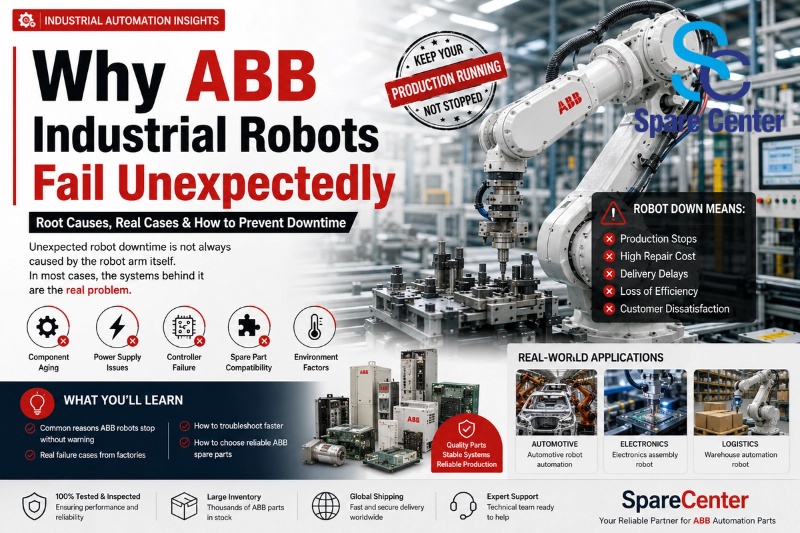
1. Aging components (the silent killer)
Most ABB systems run for years — sometimes over a decade without major replacement.
That sounds great on paper. In reality, it just means parts are slowly aging inside the cabinet.
Capacitors dry out. Cooling fans slow down. Solder joints weaken from heat cycles.
Nobody notices… until the robot stops.
This shows up a lot in:
automotive robot automation lines
electronics assembly robot stations
warehouse automation robot systems
What many engineers miss is that the robot failure is often just the final symptom, not the root cause.
We’ve seen maintenance teams replace the robot controller only to find out later the real issue was a weak power module feeding unstable voltage for weeks.
2. Spare parts that “look compatible” but aren’t
This one causes a lot of headaches.
Two ABB automation modules can look identical. Same model name. Same shape. Even same connector layout.
But internally, revision changes matter.
Firmware differences, board revisions, even small protocol updates — they all affect stability.
Here’s where things get tricky:
A mismatched module may actually work at first. Then after a few production cycles, random faults start showing up.
Intermittent errors are the worst. Because you can’t easily reproduce them.
We’ve seen factories chase “robot problems” for weeks, only to find out it was a replacement I/O board that didn’t fully match the system version.
That kind of issue usually doesn’t show up immediately. It shows up under load.
3. Power issues (often ignored, but very real)
People like to blame software. Or controllers. Or even the robot itself.
But unstable power is one of the most common causes of ABB automation failure.
Small voltage drops don’t kill the system instantly. They stress it slowly.
Servo drives work harder. Power modules heat up. Communication becomes unstable.
In welding environments, especially with ABB welding robot systems running long shifts, this becomes more obvious.
We’ve seen cases where everything looked fine during inspection, but random shutdowns happened during peak load hours.
Later? Voltage spikes from nearby heavy machinery were the cause.
Simple fix, but hard to diagnose.
4. Heat, dust, and “invisible wear”
This is something many buyers underestimate.
The robot arm can be premium grade. Doesn’t matter.
If the cabinet environment is bad, problems will show up anyway.
Dust blocks airflow. Fans lose efficiency. Heat builds up slowly.
In welding areas, metal particles make it even worse.
We’ve opened cabinets where everything looked fine at first glance — until you notice thick dust layers sitting on cooling fins and power boards.
And then it makes sense why failures happen.
Nothing dramatic. Just slow overheating over time.
5. Automotive lines push robots to their limit
In automotive robot automation, everything runs hard.
No breaks. High cycle speeds. Repeated welding patterns. Heavy payload movement.
ABB robots are built for this, but even strong systems have limits if maintenance is delayed.
What we often see is simple:
Production focuses on output. Maintenance gets postponed.
Then one small fault creates a chain reaction.
One robot stops, then upstream and downstream processes start backing up.
Downtime spreads faster than expected.
6. Electronics manufacturing is even more sensitive
With an electronics assembly robot, failure doesn’t always mean a full stop.
Sometimes the robot still runs. But accuracy slowly drifts.
That’s worse in some ways.
Because scrap increases quietly. Quality variation appears. Nobody notices immediately.
Then later someone asks: why are defect rates rising?
Common hidden causes:
minor servo degradation
small calibration drift
communication delay
aging connectors
Not dramatic failures. Just slow decay.
7. Warehouse automation: small failure, big impact
In warehouse automation robot systems, everything depends on flow.
If one unit fails, the entire logistics chain slows down.
We’ve seen cases where a single controller issue affected packing schedules during peak season.
Not because the robot was complex. But because spare parts weren’t ready.
That’s the real issue in many warehouses.
Spare parts matter more than most people think
Most companies only start looking for parts after something breaks.
That’s risky.
Especially for older ABB automation systems.
Some modules are no longer produced. Some are limited stock. Some require OEM replacement sourcing.
Experienced teams usually prepare in advance:
critical spare controllers
power supply units
I/O modules
communication boards
Because waiting during downtime is expensive. Very expensive.
ABB cobot vs industrial robot (real-world difference)
An ABB cobot is usually used for flexible, lighter tasks.
Traditional ABB industrial robots handle:
welding
heavy lifting
continuous production
high-speed cycles
In theory, both are reliable. In reality, usage environment matters more than specifications.
We’ve seen cobots perform well in flexible assembly lines, while industrial robots dominate heavy-duty automotive work.
Different tools. Different stress patterns.
What experienced engineers actually check first
When something goes wrong, experienced maintenance teams don’t start with the robot arm.
They check:
power stability
controller logs
heat inside cabinet
module revisions
communication errors
recent spare part changes
Because most failures don’t come from “one big issue”. They come from small things stacking up.
FAQs
1. Why does an ABB industrial robot suddenly stop working?
Most sudden stops come from controllers, power modules, or communication boards — not the robot arm itself.
2. What is the most common cause of ABB robotics failure?
Aging components and unstable power conditions are the most common.
3. Do ABB robots fail often?
No, but supporting systems around them degrade over time, which leads to unexpected downtime.
4. Can spare parts cause robot errors?
Yes. Even small revision mismatches can create intermittent faults.
5. Are ABB welding robots more likely to fail?
Not inherently, but welding environments create more heat, dust, and electrical stress.
6. How long do ABB industrial robots last?
Often 10–20 years, depending heavily on maintenance and spare part availability.
7. Why do electronics assembly robots fail differently?
They often don’t fully stop — instead, accuracy drifts slowly before visible failure appears.
Final thought
Most ABB robot failures don’t feel like failures at first. They start small. Quiet. Easy to ignore.
Then one day the system stops, and it looks sudden.
But in reality, it wasn’t sudden at all.
It was building up for a long time.
Recommendation
| SAFT113POW SAFT 113 POW | NBIO-21CU | IMDSM04 |
| C87-11006 | DYTP600A 6143001-ZY | IMFEC11 |
| DSCS131 57310001-LM | DTCA717A 61430001-WH | NTMF01 |
| SDCS-CON-2B 3ADT309600R0012 | DTDX707A 61430001-WG | NRDI02 |
| TU515 1SAP212200R0001 | EI803F 3BDH000017R1 | DI803 3BSE022362R1 |
| PM154 3BSE003645R1 | 3BHB003154R0101 5SXE 04-0150/3BHL000390P0104 5SHX 1960L0004 | DTPC723A 3EST000210-3450 |
| PM153 3BSE003644R1 | 3BHB012961R0001 5SHX 2645L0002 | UFC039A01 3EHL402791R0001 |
| DTCC901B 61430001-FU | SPAS011 | PM511V16 3BSE011181R1 |
| DTDX991A 61430001-UW | INNIS11 | F4332D 3HAC024322-001 |
| 07MK92 GJR5253300R3161 | IIMCL01 | HITE303278R1 |
ABB automation ABB automation ABB automation ABB automation ABB automation ABB automation ABB automation ABB automation ABB automation ABB automation ABB automation ABB automation ABB automation ABB automation ABB automation ABB automation ABB automation ABB automation ABB automation ABB automation ABB robotics ABB robotics ABB robotics ABB robotics ABB robotics ABB robotics ABB robotics ABB robotics ABB robotics ABB robotics ABB robotics ABB robotics ABB robotics ABB robotics ABB robotics ABB robotics ABB robotics ABB robotics ABB robotics ABB robotics ABB robotics ABB robotics ABB robotics ABB robotics ABB robotics ABB robotics ABB robotics ABB industrial robot ABB industrial robot ABB industrial robot ABB industrial robot ABB industrial robot ABB industrial robot ABB industrial robot ABB industrial robot ABB industrial robot ABB industrial robot power module power module power module power module power module power module power module power module power module power module power module power module power module power module power module power module power module power module power module power module power module power module power module power module power module automation system automation system automation system automation system automation system automation system automation system automation system automation system automation system automation system automation system automation system automation system automation system automation system automation system automation system
If you want to more details,please contact me without hesitate.Email:sales@sparecenter.com