

Written by Tina Jiang, Director at Spare Center
Tina Jiang is the Sales Director at Spare Center and brings more than 12 years of experience in the automation industry. Over the years, she has worked closely with a wide range of clients and gained a practical understanding of automation technologies, market trends, and real-world customer needs.
Her work focuses on building long-term client relationships and supporting business growth across different markets. With a hands-on approach and solid industry experience, she enjoys sharing insights that come from day-to-day work in the field.
IntroductionIn industrial automation, ABB drives are often treated as “install and forget” components. But in real projects, that mindset is exactly where problems start. A drive system only performs as well as its environment allows it to. Voltage instability, improper motor matching, poor cabinet heat design, or even packaging vibration during shipment can quietly damage performance long before commissioning. A modern automation line—whether it’s packaging automation, welding automation system, or a palletizing robot solution—depends heavily on stable motion control. That’s where ABB systems like ABB drives and motors come into play. Here’s the thing: most failures we see in the field are not “product failures.” They are system integration failures. Why ABB Drives Are So Widely Used in Industrial ProjectsTo understand failure, we first need to understand why engineers choose ABB in the first place. In OEM and factory automation projects, ABB equipment is commonly selected for:
For example, ABB ACS880 is widely used in conveyor systems, extrusion lines, and heavy-duty motor control because it supports both vector control and direct torque control modes. In practice, ABB motor drives are often paired with ABB motors in systems where load variation is unpredictable—like packaging lines or robotic palletizing cells. |
|
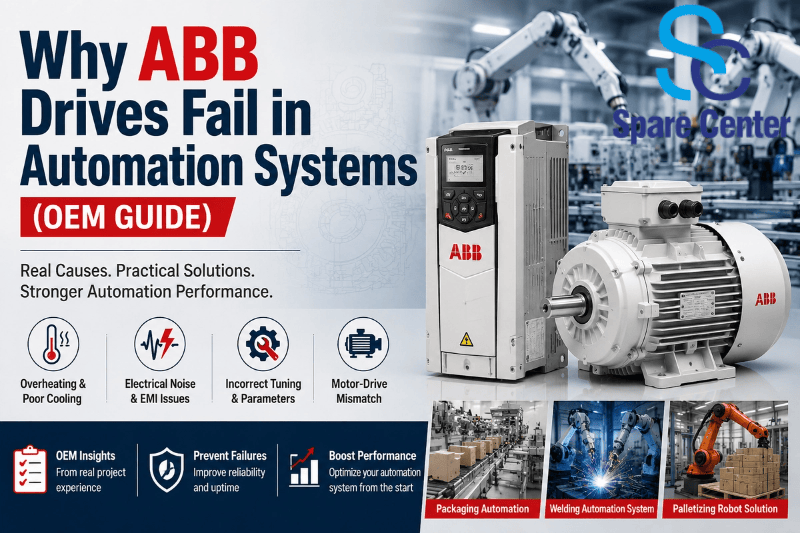
Why ABB Drives Fail in Real Projects (OEM Perspective)
Honestly, this is where many buyers get confused.
They expect the drive to “just work,” but in OEM engineering, nothing works in isolation.
1. Heat design mistakes in control cabinets
We’ve seen cases where ABB drives fail within 6–12 months simply because the cabinet airflow was underestimated.
A typical mistake:
Drive rated for 45°C ambient
Cabinet actually running at 55–60°C during summer peak
What happens next?
Thermal derating → random shutdown → parameter corruption → “drive failure” report
But the drive itself? Still fine.
2. Motor-drive mismatch (very common in retrofits)
ABB motors and third-party motors are often mixed in retrofit projects.
This creates issues like:
Torque ripple at low speed
Overcurrent trips during acceleration
Encoder feedback instability
In one packaging automation project, a client paired ABB motor drives with a non-standard servo motor. On paper, specs looked compatible. In reality, resonance appeared at mid-speed range, causing unstable film feeding in shrink-wrapping machines.
3. Electrical noise in welding automation systems
Welding environments are brutal.
High-frequency interference from welding automation system lines often affects drive communication.
Symptoms:
Random fault codes
Communication drop with PLC
Unstable speed reference
This is not rare. It’s actually expected unless proper shielding and grounding are designed from day one.
4. Poor parameter tuning after installation
Here’s a hard truth from field experience:
Most ABB drives are never tuned properly after installation.
Default parameters are not optimized for:
Load inertia differences
Belt tension variations
Mechanical backlash
In palletizing robot solution setups, this leads to jerky motion and reduced cycle speed—even though hardware is perfectly fine.
ABB Motors and System-Level Stability
When engineers talk about stability, they usually blame the drive. But ABB motors play an equally important role.
ABB motors are designed for:
High efficiency under continuous duty
Stable torque output under load fluctuation
Long-term thermal endurance
However, what many buyers overlook is mechanical coupling quality.
We once saw a case in a food packaging line where motor alignment deviation of just 0.3 mm caused bearing wear within three months. The motor was not defective—the installation process was.
Packaging, Shipping, and OEM Reality (Often Ignored)
Here’s something rarely discussed.
In OEM/ODM supply chains, packaging quality directly affects product reliability.
We’ve seen:
Drive PCBs loosen after long-distance vibration
Terminal screws slightly shifted after sea freight
Moisture ingress in poorly sealed export cartons
Many industrial buyers focus too much on electrical specs and ignore packaging engineering. But for ABB electrification components shipped globally, packaging is part of product reliability.
ABB Electrification in Modern Automation Lines
Today, ABB electrification solutions are no longer just about drives or motors.
They are part of integrated systems:
Smart distribution panels
Energy-efficient motor control
Predictive maintenance systems
Industrial IoT monitoring layers
In advanced factories, ABB motor drives are now connected directly to cloud dashboards for predictive load analysis.
Real-World Application Scenarios
Packaging automation
Stable speed control is critical for sealing accuracy and film alignment.
Welding automation system
Requires strong EMI resistance and precise torque response.
Palletizing robot solution
Depends on synchronized multi-axis ABB servo motor coordination for cycle speed optimization.
FAQs
1. Why do ABB drives trip unexpectedly?
Most cases are caused by overheating, poor grounding, or motor parameter mismatch rather than internal failure.
2. Can ABB ACS880 work with non-ABB motors?
Yes, but tuning is required. Without proper parameter setup, torque instability may occur.
3. What is the lifespan of ABB motor drives?
Typically 8–15 years depending on load conditions and thermal management.
4. Why is my ABB motor vibrating at low speed?
Usually caused by incorrect vector control tuning or mechanical resonance.
5. Are ABB drives suitable for welding automation systems?
Yes, but EMI shielding and grounding must be designed properly.
6. What is the biggest mistake in packaging automation using drives?
Ignoring tension control and acceleration/deceleration curve tuning.
7. Do ABB electrification systems support predictive maintenance?
Yes, newer systems support IoT-based monitoring and diagnostics.
Conclusion
ABB systems are not “plug-and-play automation magic boxes.” They are precision industrial tools that depend heavily on system design, installation quality, and environmental control.
In real OEM projects, success is rarely about choosing the right brand alone. It’s about how ABB drives, motors, and electrification systems are integrated into the full production ecosystem.
When everything is engineered correctly, performance is stable, predictable, and long-lasting. When it’s not, even the best equipment will look unreliable.
Recommendation
| SAFT163IOC SAFT 163 IOC | SA811F 3BDH000013R1 | CMA136 3DDE300416 |
| SNAT6030BEB SNAT 6030 BEB | DI830 3BSE013210R1 | CMA127 3DDE300407 |
| HESG330086R64 HE693116-307 | DSQC609 3HAC14178-1 PBSE5117 | CMA35 GVT3605799 |
| SAFT181INF SAFT 181 INF | SDCS-CON-1 3BSE006196R1 | CMA122 3DDE300402 |
| SAFT103CON 57777290 SAFT 400F380E 57778865 | SDCS-IOB-21 3BSE005176R1 | CMA137 3DDE300417 |
| SAFT171PAC SAFT 171 PAC | SDCS-PIN-48 3BSE004939R0002 | AI620 3BHT300005R1 |
| SAFT103CONB SAFT315F380 | DO880 3BSE028602R1 | AO650 3BHT300051R1 |
| SAFT172POW SAFT 172 POW | 3HAC16035-1 | CI610 3BHT300003R1 |
| SAFT103CON SAFT 103 CON | CMA124 3DDE300404 | CI626V1 3BSE012868R1 |
| 07KT93 GJR5251300R0171 | CMA131 3DDE300411 | DI620 3BHT300002R1 |
If you want to more details,please contact me without hesitate.Email:sales@sparecenter.com
ABB ABB ABB ABB drives ABB drives ABB drives ABB drives ABB drives ABB drives ABB drives ABB drives ABB drives ABB drives ABB drives ABB drives ABB drives ABB drives ABB drives ABB drives ABB drives ABB drives ABB drives ABB drives ABB drives ABB drives ABB drives ABB drives ABB motors ABB motors ABB motors ABB motors ABB motors ABB motors ABB motors ABB motors ABB motors ABB motors ABB motors ABB motors ABB motors ABB motors ABB motors ABB motors ABB motors ABB motors ABB motors ABB motors ABB motors ABB motors ABB motors ABB motors packaging automation packaging automation packaging automation packaging automation packaging automation packaging automation packaging automation packaging automation packaging automation packaging automation palletizing robot solution palletizing robot solution palletizing robot solution palletizing robot solution palletizing robot solution palletizing robot solution palletizing robot solution palletizing robot solution palletizing robot solution ABB motor drives ABB motor drives ABB motor drives ABB motor drives ABB motor drives ABB motor drives ABB motor drives ABB motor drives ABB motor drives ABB motor drives ABB motor drives ABB motor drives ABB motor drives ABB motor drives packaging automation