
About Author
Written by Tina Jiang , Director of Spare Center
Tina Jiang has accumulated several years of experience in industrial sales and technical support, with a strong focus on automation systems and machine condition monitoring. In her daily work, she communicates closely with customers, prepares quotations, and recommends appropriate solutions for industrial control and monitoring needs. She also assists clients in sourcing replacement components, including hard-to-find or discontinued parts. Additionally, she coordinates with engineering teams and suppliers to ensure smooth project progress—helping maintain timely deliveries and competitive pricing so customers can minimize equipment downtime and keep operations running efficiently.
Introduction
A Yokogawa DCS system is not something you notice in a plant when everything is running normally.
It’s just there—quietly keeping pressure, temperature, and flow within range while operators focus on production targets.
But when something goes wrong, you immediately realize how much the whole plant depends on it.
We’ve seen situations where a single unstable control loop triggered a cascade of alarms across multiple units. Nothing was physically damaged, but operations had to slow down just to regain stability.
This is where Yokogawa Electric has built its reputation—especially in industries where downtime is not just inconvenient, but expensive.
And honestly, a lot of confusion comes from mixing up DCS, SCADA, and PLC systems as if they solve the same problem. In real projects, they don’t.
What is Yokogawa DCS actually used for?If you strip away all the technical documentation, a DCS is essentially responsible for one thing: keeping industrial processes stable under constantly changing conditions. In practical terms, it:
It sounds straightforward, but industrial processes are rarely stable. For example, in a chemical reaction unit, even small temperature deviations can affect product quality hours later. Operators often don’t see the issue immediately—it appears later as off-spec batches. That’s exactly why systems like Yokogawa’s CENTUM platform are widely used in continuous process industries. We once reviewed a plant where operators were manually tuning PID loops across different PLC systems. It “worked,” but the behavior was inconsistent from shift to shift. After migrating key loops into a unified DCS structure, stability didn’t become perfect—but it stopped drifting unpredictably. That alone made operations far more manageable. How Yokogawa fits into industrial automationIndustrial automation is often presented as a clean layered model, but in real plants it is more complicated. A typical structure looks like this:
Yokogawa Electric is mainly positioned in the control and measurement layer, but what makes it relevant is the tight connection between measurement accuracy and control performance. This point is often underestimated. We’ve seen plants where SCADA dashboards looked perfectly normal, while actual field measurements were slowly drifting due to aging transmitters. The control system kept reacting—but based on slightly incorrect data. These are the kinds of issues that don’t show up in simulation tests. | 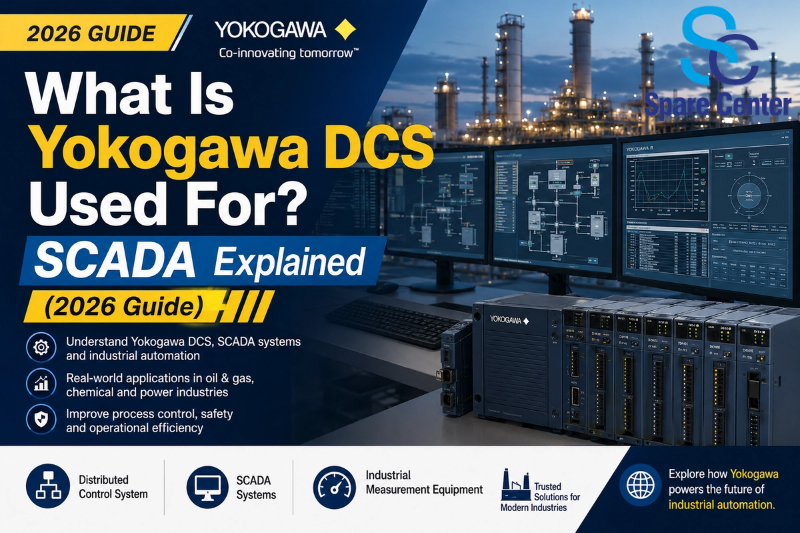 |
Why SCADA systems still matter in 2026
How Yokogawa control systems work in chemical plants
Chemical plants are not stable systems. They are constantly moving away from equilibrium and require continuous correction.
A typical control architecture includes:
Redundant controllers for reliability
Fast and deterministic communication networks
Safety instrumented systems for protection
Batch and continuous process control logic
What is often missed in early design stages is that control performance depends heavily on input quality.
If a flow transmitter is drifting by even a small percentage, the controller will still respond—but to incorrect values.
We’ve seen cases where engineers spent weeks adjusting PID parameters, only to discover later that the real issue was instrument calibration drift.
In practice, this happens more often than most people expect.
Yokogawa industrial automation in oil and gas plants
Oil and gas facilities are among the most demanding environments for industrial automation systems.
They involve:
High-pressure process lines
Offshore and remote installations
Continuous refining and separation processes
Strict safety requirements
In these environments, failure is not just a technical issue—it can quickly become a safety risk.
Yokogawa Electric systems are widely deployed because they support:
Fault-tolerant control architecture
High-integrity safety systems
Stable long-distance communication
Integrated real-time monitoring
From field experience, most operational problems are not caused by total system failure.
They are caused by small deviations—slow drift in signals, minor misalignment in calibration, or delayed detection of abnormal trends.
These issues accumulate quietly over time.
OEM/ODM perspective in industrial automation hardware
From an OEM/ODM engineering point of view, industrial automation equipment is not about appearance or specifications alone.
It is about long-term stability under stress.
Key requirements usually include:
Long lifecycle support (10–15 years minimum)
Firmware stability across hardware revisions
Resistance to vibration and thermal cycling
Consistent component sourcing over time
One area that is often underestimated is packaging and transportation handling.
We have seen control modules pass factory testing without issues, but later fail intermittently after shipping due to slight connector loosening caused by vibration.
These failures are difficult to diagnose because they are not constant—they appear only under certain conditions.
This is why mechanical and packaging design is part of electrical reliability in industrial systems.
Common misunderstandings in real projects
There are a few recurring misunderstandings in industrial automation projects:
Many people assume DCS is just a larger PLC system.
In reality, the architecture and design philosophy are different.
Some believe SCADA can fully replace DCS.
That only works in low-risk or non-continuous processes.
Others think adding more sensors automatically improves control performance.
In practice, it can sometimes increase noise and make troubleshooting harder.
Another overlooked issue is calibration drift.
Systems rarely fail suddenly. They slowly become less accurate while still appearing to operate normally.
That is usually when problems become hardest to detect.
FAQs
1. What is Yokogawa DCS used for?
It is used for real-time control of industrial processes such as refining, chemical production, power generation, and large-scale manufacturing.
2. How do Yokogawa control systems work in chemical plants?
They use continuous feedback loops, redundant controllers, and safety layers to maintain stable operating conditions for temperature, pressure, and flow.
3. What is the difference between DCS and SCADA?
DCS is responsible for real-time process control. SCADA focuses on monitoring, visualization, and supervisory-level control across systems or sites.
4. Why is Yokogawa widely used in oil and gas plants?
Because it provides high reliability, fault-tolerant design, and strong integration between control systems and industrial measurement equipment.
5. What usually causes automation system failures?
Most issues come from integration problems, sensor drift, or incorrect field data—not from controller hardware failure.
Conclusion
Industrial automation systems rarely fail in obvious ways.
More often, issues develop slowly—from small measurement drift, slight configuration inconsistencies, or integration gaps between systems.
Yokogawa Electric remains widely used in heavy industries because its systems are designed around these real-world imperfections, not ideal conditions.
In actual plant environments, what matters most is not how advanced a system looks on paper—but how stable it remains after months or years of continuous operation.
Top-ranked Models
| PW481-50 | ATD5A-00 S1 | SDV541-S63 S3 |
| SB401-50 S1 | ATI3S-00 S2 | ALR121-S51 S1 |
| EB501-50 S2 | ALE111-S50 S1 | EC401-50 S3 |
| AAI143-H53 S1 | ADV161-P50 S2 | ASS9981DE-02 |
| ADV151-P53 S2 | AAT141-S03 S2 | SPW482-13 S1 |
| AAI543-S53 S1 | SPW482-E3 S1 | PW481-10 S2 |
| AAI135-S00 S2 | AAI543-S03 S1 | AIP562 S1 |
| AAT145-S53 S1 | SAI143-S03 S2 | MR6-16-2*A MR6-16-2*A/BU |
| AAI543-H03 S1 | AAR181-S53 S2 | AAI835-S50 S3 |
| ANT502-5F S1 | AAR145-S53 S1 | ASS9881 DE-02 |
If you want to more details,please contact me without hesitate. Email:sales@sparecenter.com
#SteamTurbineSpare Yokogawa Yokogawa Yokogawa Yokogawa Yokogawa Yokogawa Yokogawa Yokogawa Yokogawa Yokogawa Yokogawa Yokogawa Yokogawa Yokogawa Yokogawa Yokogawa Yokogawa Yokogawa Yokogawa Yokogawa Yokogawa Yokogawa Yokogawa Yokogawa Yokogawa Yokogawa Yokogawa Yokogawa Yokogawa Electric Yokogawa Electric Yokogawa Electric Yokogawa Electric Yokogawa Electric Yokogawa Electric Yokogawa Electric Yokogawa Electric Yokogawa Electric Yokogawa Electric Yokogawa Electric Yokogawa Electric Yokogawa Electric Yokogawa Electric Yokogawa Electric Yokogawa Electric Yokogawa Electric Yokogawa Electric industrial automation industrial automation industrial automation industrial automation industrial automation industrial automation industrial automation industrial automation industrial automation industrial automation industrial automation industrial automation SCADA systems SCADA systems SCADA systems SCADA systems SCADA systems SCADA systems SCADA systems SCADA systems SCADA systems SCADA systems SCADA systems SCADA systems SCADA systemsSCADA systems SCADA systems SCADA systems SCADA systems SCADA systems SCADA systems SCADA systems SCADA systems SCADA systems SCADA systems SCADA systems SCADA systems how Yokogawa control systems work in chemical plants how Yokogawa control systems work in chemical plants how Yokogawa control systems work in chemical plants how Yokogawa control systems work in chemical plants how Yokogawa control systems work in chemical plants how Yokogawa control systems work in chemical plants how Yokogawa control systems work in chemical plants how Yokogawa control systems work in chemical plants how Yokogawa control systems work in chemical plants