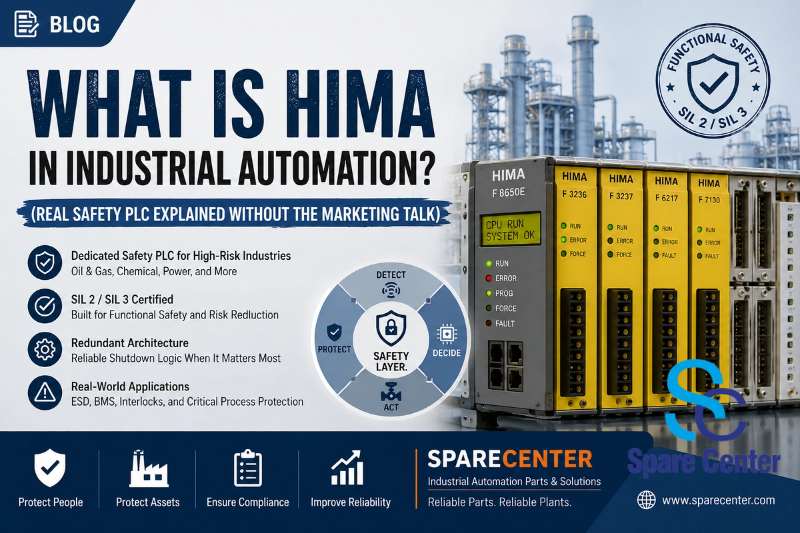

What Is HIMA in Industrial Automation? (Real Safety PLC Explained Without the Marketing Talk)

2026-06-24


Written by Tina Jiang, Director at Spare Center

Tina Jiang is the Sales Director at Spare Center and brings more than 12 years of experience in the automation industry. Over the years, she has worked closely with a wide range of clients and gained a practical understanding of automation technologies, market trends, and real-world customer needs.

Her work focuses on building long-term client relationships and supporting business growth across different markets. With a hands-on approach and solid industry experience, she enjoys sharing insights that come from day-to-day work in the field.

Introduction

A safety system in industrial automation is basically the last line of defense. When something goes wrong—pressure spikes, gas leaks, temperature runaway—it’s not the normal PLC that saves the plant. It’s the safety layer.

HIMA is one of the most widely used safety PLC systems in high-risk industries like oil & gas, chemical plants, and power generation.

In simple engineering terms:

A HIMA system is a dedicated Safety Instrumented System (SIS) designed to detect dangerous conditions and force the process into a safe state.

We’ve noticed a common misunderstanding in real projects: people assume “PLC is PLC.”
Honestly, that assumption usually breaks the design later during commissioning.


What Does HIMA Mean? (HIMA Meaning & Definition)

HIMA is a German company focused entirely on functional safety systems.

HIMA meaning

It refers to safety PLC platforms used for:

  • Emergency shutdown (ESD)

  • Burner management systems (BMS)

  • Process interlock safety

  • Critical alarm handling

HIMA definition (in real plant language)

It’s not a “control PLC.”

It’s a fail-safe decision system that only has one job:
keep the plant from entering unsafe conditions—even if everything else is still running.

That distinction sounds small, but in engineering practice it changes everything.

HIMA

How a HIMA Safety System Actually Works

Here’s the basic flow, but stripped down to real logic—not textbook explanation:

  • Sensors detect process conditions (pressure, gas, temperature)

  • Signals go into redundant input modules

  • Safety CPU runs logic checks (often 1oo2 or 2oo3 voting)

  • If something is outside safe limits → shutdown logic is triggered

  • Outputs cut fuel, close valves, or stop equipment

What many people overlook is this part:
Even wiring noise or grounding issues can trigger a shutdown.

We’ve seen plants where everything looked fine on paper, but random trips happened during startup. Later it turned out to be shielding and panel layout—not the logic itself.

This is where real commissioning experience matters.


Process Safety Automation and SIL Reality

Process safety automation is not just a compliance term. It’s what prevents explosions, equipment damage, and sometimes worse.

HIMA systems are typically certified for:

  • SIL 2

  • SIL 3 (most critical applications)

But here’s the part engineers don’t talk about much:

SIL is not just the controller.

It includes:

  • Sensor reliability

  • Wiring quality

  • Logic solver architecture

  • Maintenance testing intervals

  • Documentation discipline

If one part is weak, the whole SIL claim becomes questionable.

That’s why auditors usually spend more time on documentation than hardware.


HIMA PLC vs Siemens Safety System (Real Comparison)

This is a question that comes up in almost every EPC discussion.

Siemens safety PLC:

  • Integrated into full automation stack

  • Easier engineering workflow

  • More flexible for mixed control + safety environments

HIMA system:

  • Dedicated safety-only architecture

  • Strong isolation between control and safety

  • Common in oil & gas and refinery standards

Real project reality:

In many plants, you don’t choose one or the other.

You often see:

  • Siemens handling process control

  • HIMA handling shutdown logic

And honestly, that separation exists for a reason. Safety logic behaves differently than control logic. Mixing them can create risk during software changes.


OEM / Spare Parts Reality in the Field

In real industrial maintenance, the biggest issue is not initial design—it’s what happens 5–10 years later.

That’s where supply chain matters.

Platforms like Sparecenter
Sparecenter HIMA Products
are often used by maintenance teams to source compatible modules, replacement parts, and legacy system support.

What matters in practice:

  • Same revision compatibility (not just model number)

  • Long-term availability

  • Proper packaging for export (these modules are sensitive)

  • Avoiding mixed-generation hardware in one rack

We’ve seen shutdown delays caused simply because one I/O module revision was no longer available.

That kind of problem rarely shows up in design phase.


Common Engineering Mistakes with HIMA Systems

This is where things usually go wrong in real projects:

  • Treating safety PLC like a normal PLC

  • Poor grounding and EMC design in cabinets

  • Incorrect redundancy configuration

  • Mixing safety and non-safety signals in the same structure

  • Weak proof test planning

Here’s the problem:
Most failures don’t come from
HIMA hardware itself. They come from integration decisions.


Where HIMA Is Used in Real Industry

You’ll usually find HIMA systems in:

  • Refineries (ESD, flare control)

  • Offshore platforms

  • LNG terminals

  • Chemical reactors

  • Power plants (boiler protection)

A typical cabinet is not simple:

  • Redundant CPUs

  • Distributed I/O systems

  • Safety communication links

  • Hardwired emergency loops

It’s built for one purpose: assume failure will happen somewhere, and still stay safe.


FAQ

1. What is HIMA in industrial automation?

It is a Safety Instrumented System (SIS) used to detect hazards and trigger safe shutdown actions in industrial plants.

2. What does HIMA stand for?

HIMA refers to HIMA Paul Hildebrandt GmbH, a German company specializing in safety automation systems.

3. Is HIMA a PLC or safety system?

It is a safety PLC, but functionally it behaves more like a dedicated safety decision system than a normal controller.

4. How does HIMA safety system work?

It uses redundant inputs, voting logic, and fail-safe outputs to ensure dangerous conditions trigger automatic shutdown.

5. HIMA PLC vs Siemens safety system—what’s the difference?

HIMA is dedicated to safety systems only, while Siemens integrates safety into general automation platforms.

6. What is SIL certification in HIMA systems?

SIL defines the required risk reduction level, typically SIL 2 or SIL 3 in industrial applications.

7. Where is HIMA commonly used?

Oil & gas, chemical processing, power generation, and offshore industrial facilities.

8. Why are HIMA systems still widely used?

Because many EPC standards and legacy plants already rely on it, and replacement requires full safety revalidation.


Conclusion

HIMA systems sit in a very specific part of industrial automation: they are not about making processes run, but about making sure they stop safely when something goes wrong.

In real engineering work, the difference is not just brand choice. It’s how well the safety layer is designed, installed, and maintained over time.

And in most real plants, that’s where the real risk actually lives.


Recommendation

BOSCH BF200T BF 200 T I-C-B-TLP1D65004BD 131L9795 VLT FC-101P1K5T2E20H4
06F41-RS0B0-A11N-ST5S00N-R0SUHYDAC EDS 348-5-100-0006ES73135BF030AB0
0608800063S500B060R000 090800983441561000 1XK8249 
SX4R03FB4BA20160KVP3E01
RKH0011/005,0 R911343795 /AA10338-53000LEUZE ROTOSCAN RS4-4 50034195
4220-1491-05O444 R1S 60VOLTS 3394037PERCEPTRON 500-0243 
B&R ACOPOS 1010 8V1010.50-2REO-444-R1PCD2M127
HOMA PS25-D4 8234584891.34.1998 891341998 7568305 0207 DSA6MR50AQJYEU
SICK KTX-WP91141242ZZZZ 1078101 BCL-32-R1-F-100 50036273SGDB10VD
E1000-MT 0150-1615BSH0702M01A1A 65032201-003 769828 5.0300.01.07.50.03
DGC-32-500-G-PPV-A 5324486XV14404BH80 ABB DAM11000 2CMA139255R1000
BENTLY NEVADA 3500 3500/42380030 05091246 STOBER 2290226 P421SGZ0080ME

If you want to more details,please contact me without hesitate.Email:sales@sparecenter.com  

HIMA meaning HIMA meaning HIMA meaning HIMA meaning HIMA meaning HIMA meaning HIMA meaning HIMA meaning HIMA meaning HIMA meaning HIMA meaning HIMA meaning HIMA meaning HIMA meaning HIMA meaning HIMA meaning HIMA meaning HIMA meaning HIMA meaning HIMA meaning HIMA meaning HIMA meaning HIMA meaning HIMA meaning HIMA meaning HIMA meaning HIMA definition HIMA definition HIMA definition HIMA definition HIMA definition HIMA definition HIMA definition HIMA definition HIMA definition HIMA definition HIMA definition HIMA definition HIMA definition HIMA definition HIMA definition HIMA definition HIMA definition HIMA definition HIMA definition HIMA definition HIMA definition HIMA safety system how it works HIMA safety system how it works HIMA safety system how it works HIMA safety system how it works HIMA safety system how it works HIMA safety system how it works HIMA safety system how it works HIMA safety system how it works HIMA safety system how it works HIMA safety system how it works HIMA PLC vs Siemens safety system HIMA PLC vs Siemens safety system HIMA PLC vs Siemens safety system HIMA PLC vs Siemens safety system HIMA PLC vs Siemens safety system HIMA PLC vs Siemens safety system HIMA PLC vs Siemens safety system


Get the latest price? We will reply as soon as possible (within 12 hours)

Sparecenter sells new and surplus products and develops channels for purchasing such products. This website has not been approved or recognized by any of the listed manufacturers or trademarks. Sparecenter is not an authorized distributor, dealer, or representative of the products displayed on this website. All product names, trademarks, brands, and logos used on this website are the property of their respective owners. The description, explanation, or sale of products with these names, trademarks, brands, and logos is for identification purposes only and is not intended to indicate any association with or authorization from any rights holder.
("[type='submit']")