

Written by Tina Jiang, Director at Spare Center
Tina Jiang is the Sales Director at Spare Center and brings more than 12 years of experience in the automation industry. Over the years, she has worked closely with a wide range of clients and gained a practical understanding of automation technologies, market trends, and real-world customer needs.
Her work focuses on building long-term client relationships and supporting business growth across different markets. With a hands-on approach and solid industry experience, she enjoys sharing insights that come from day-to-day work in the field.
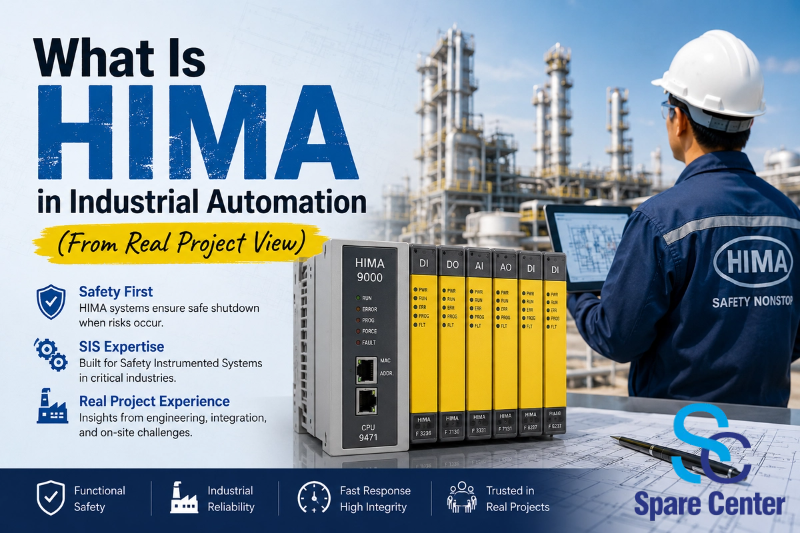
IntroductionIf you’ve ever worked around refinery control rooms or safety shutdown panels, you probably already heard the name HIMA more than once. Most people first search for HIMA meaning or HIMA definition, expecting a clean textbook answer. But honestly, in real projects, nobody really talks like that. They usually just say: That tells you everything already. A HIMA safety system is basically used when nobody wants to take responsibility for “almost safe” situations. It’s the layer that decides what happens when things go wrong — not in theory, but in real plant conditions where pressure spikes, sensors drift, or someone mis-wires a loop during shutdown maintenance. So What Is HIMA in Industrial Automation?Technically, HIMA (HIMA Group) is a German manufacturer of Safety Instrumented Systems (SIS). But that description is too clean. In real engineering terms, HIMA is usually treated as:
And this separation is the key point. A lot of junior engineers confuse it with a normal PLC. It’s not the same category, even if the hardware looks similar on paper. You’ll see it mostly in:
|
|
HIMA Meaning vs HIMA Definition (Why People Get Confused)
When people search HIMA meaning, they usually expect something simple like “it’s a controller brand”.
But in actual project documents, it’s more layered:
On procurement sheets → it’s a product line
On engineering drawings → it’s a safety architecture
On site → it’s “the system you don’t touch unless you really have to”
That gap is important.
Because in real commissioning, nobody cares about definitions. They care about:
“Did it trip correctly?”
“Why didn’t it reset?”
“Who bypassed this loop?”
How HIMA Safety System Actually Works (Field Version)
Textbooks explain it as input → logic → output.
But in real plants, it feels more like this:
Sensors start drifting (slowly, almost invisible)
Some alarm gets ignored because it happens too often
One day it’s not noise anymore — it’s real
HIMA shuts everything down faster than operators can react
That’s usually how people notice it works.
The HIMA safety system how it works question is less about architecture and more about timing and trust.
Because once it triggers, production is already stopped.
And restarting a plant is never just “press reset”.
HIMA PLC vs Siemens Safety System (What Actually Happens in Projects)
This comparison comes up in almost every EPC discussion.
On paper:
HIMA → dedicated SIS system
Siemens → integrated automation + safety PLC
But in reality, decision-making is rarely technical alone.
Here’s what many buyers overlook:
If the plant already runs Siemens DCS, switching to something else for safety might look “better technically” but becomes a nightmare during integration.
We’ve seen projects where engineers insisted on HIMA because of SIL preference, but later spent weeks solving communication mapping issues that nobody mentioned in the design phase.
So the truth is:
Engineering logic vs project reality are not always aligned.
What You Don’t See in Brochures
This is where things get tricky.
Most safety system failures are not dramatic hardware failures.
They come from small, boring mistakes:
wrong loop check documentation
mislabeled terminals
vibration loosened wiring after shutdown restart
someone bypassed a signal during maintenance and forgot to restore it
We once saw a case where everything tested fine during FAT, but failed during startup because a field junction box was replaced with a “compatible” one that wasn’t actually pinned the same.
Nobody catches these things in datasheets.
OEM / ODM Side of HIMA-Related Systems
From manufacturing and OEM perspective, most HIMA-related work is not about inventing new tech.
It’s about consistency.
Typical OEM/ODM scope includes:
control cabinet integration
rack assembly and wiring
pre-tested safety logic loading
export packaging for EPC shipment
vibration and transport reinforcement
Here’s something people outside factories don’t realize:
A system can pass all functional tests in the workshop, and still fail in the field because of mechanical stress during shipping or installation handling.
That’s why packaging and cabinet structure sometimes matter just as much as electronics.
Technical Snapshot (But Keep It Real)
Instead of repeating brochure specs, here’s what matters in practice:
SIL2 / SIL3 environments (common requirement)
Redundant architecture (because single point failure is not acceptable)
Fast response (milliseconds matter only when something is already going wrong)
Long lifecycle stability (plants don’t replace SIS every 2 years)
But again, specs are just baseline.
Real value shows up when the system survives:
unstable power supply conditions
noisy industrial environments
messy field wiring situations
FAQs
1. What is HIMA in industrial automation really used for?
It’s used to stop industrial processes safely when something abnormal happens — especially in high-risk plants.
2. Is HIMA just another PLC?
Not really. It behaves like a controller, but it’s designed specifically for safety logic and certified shutdown functions.
3. Why do oil and gas plants use HIMA systems?
Because downtime and accidents are extremely expensive, and safety systems must be independent and reliable.
4. HIMA vs Siemens safety system — which is better?
There is no universal answer. It depends heavily on existing plant architecture and integration cost.
5. What does HIMA meaning refer to in documents?
It usually refers to the HIMA brand and its safety instrumented system platform.
6. What is the biggest cause of SIS problems?
Not hardware failure — usually wiring, configuration, or human error during maintenance.
7. Can a HIMA system fail in real life?
Yes, but most “failures” come from field conditions or engineering mistakes, not core system design.
Conclusion
If you strip away marketing language, HIMA definition is actually simple:
It’s a system that exists for the moment everyone hopes never happens.
In real industrial automation, the value of a functional safety system is not how often it runs — but how correctly it reacts when everything else is already unstable.
And that’s also why engineers trust it, even if they don’t talk about it much.
Because in most plants, safety systems are not “features”.
They are the last decision-maker.
Recommendation
| F6705 | F8621 | F3330 |
| F7130A | F7541 | F6217 |
| F7131 | HIMATRIX F30 HIMATRIXF30 | F6705 |
| F7133 | F8650E | F7130A |
| F7553 | F3221 | F7131 |
| Z7127 | F3349 | F3226 |
| Z7138 | F8620 | F3 AIO 8/4 01 F3AIO8/401 |
| Z7128 | HIMATRIX F2DO1601 F2DO16 01 | 42300 |
| F6205 | F3421 | F6251 |
| F3349 | F6215 | 52100 |
If you want to more details,please contact me without hesitate.Email:sales@sparecenter.com
HIMA HIMA HIMA HIMA HIMA HIMA HIMA HIMA HIMA HIMA HIMA HIMA HIMA HIMA HIMA HIMA HIMA meaning HIMA meaning HIMA meaning HIMA meaning HIMA meaning HIMA meaning HIMA meaning HIMA meaning HIMA meaning HIMA meaning HIMA meaning HIMA meaning HIMA meaning HIMA meaning HIMA meaning HIMA meaning HIMA meaning HIMA meaning HIMA meaning functional safety system functional safety system functional safety system functional safety system functional safety system functional safety system functional safety system functional safety system functional safety system functional safety system safety instrumented system safety instrumented system safety instrumented system safety instrumented system safety instrumented system safety instrumented system safety instrumented system safety instrumented system industrial automation safety industrial automation safety industrial automation safety industrial automation safety instrumented system safety industrial automation safety industrial automation safety industrial automation safety industrial automation safety industrial automation safety industrial automation safety