
Written by Tina Jiang, Director at Spare Center
Tina Jiang is the Sales Director at Spare Center and brings more than 12 years of experience in the automation industry. Over the years, she has worked closely with a wide range of clients and gained a practical understanding of automation technologies, market trends, and real-world customer needs.
Her work focuses on building long-term client relationships and supporting business growth across different markets. With a hands-on approach and solid industry experience, she enjoys sharing insights that come from day-to-day work in the field.
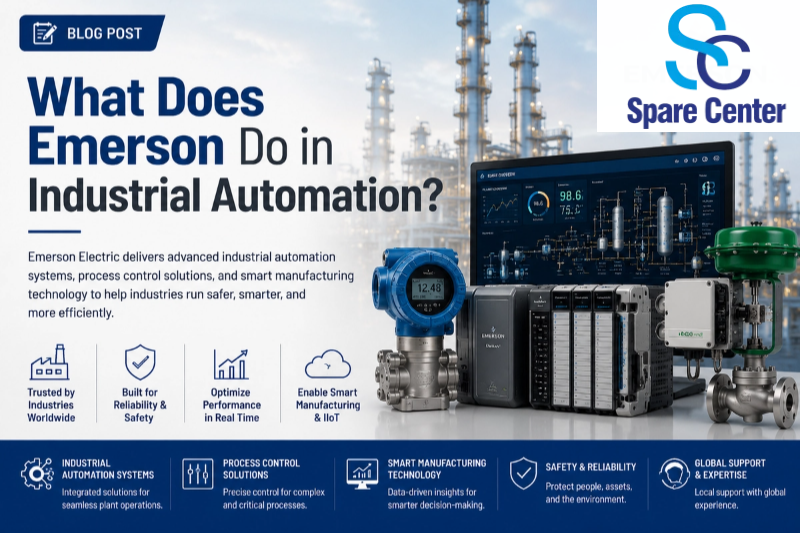
IntroductionIndustrial automation today is not just about machines running automatically. In most factories, the real challenge is keeping the entire process stable over time — especially when conditions change every day. A simple way to understand it: Emerson Electric Co. plays a key role in maintaining stability inside modern industrial automation systems. In many oil, gas, and chemical projects, Emerson is not something operators talk about every day. It sits quietly in the background, handling control logic, measurement, and system reliability. And honestly, that’s usually how good industrial systems are designed — you don’t notice them until something goes wrong. Emerson in Industrial Automation SystemsWhen we talk about industrial automation systems, Emerson is usually involved in multiple layers, not just one device or product. In real projects, it typically covers:
So when engineers mention Emerson, they are often referring to a full control architecture rather than a single product line. This is also where many beginners misunderstand things. They assume industrial automation systems are just sensors connected to a controller. In reality, the complexity comes from long-term stability — not initial setup. |
|
Process Control Solutions in Real Operations
If we focus on process control solutions, Emerson’s role becomes more obvious.
In oil refineries or chemical plants, process conditions are constantly changing:
temperature fluctuates
pressure shifts under load
flow rates vary depending on upstream conditions
A stable system has to adjust all of this in real time without creating oscillation or drift.
In practice, Emerson process control solutions are often used to:
maintain pressure stability in pipelines
regulate chemical reaction conditions
control valve response accuracy
reduce long-term process deviation
Here’s the thing — most people only look at whether the system works on day one. But in industrial environments, day one performance is not the real benchmark.
Six months later is.
Smart Manufacturing Technology and Real-World Expectations
In the context of smart manufacturing technology, the expectations are often misunderstood.
People think it means full automation or AI-driven factories.
But in real engineering environments, it usually means something simpler:
the system can detect small changes before they become real problems.
This is where Emerson systems are often applied.
For example:
detecting gradual sensor drift
identifying valve degradation early
monitoring process efficiency trends
adjusting control loops dynamically
We’ve seen many factories where everything “looks fine” on dashboards, but efficiency slowly drops over time.
This is not a failure — it’s just undetected variation.
And that’s exactly what smart manufacturing technology is supposed to solve.
Emerson Automation Solutions in Engineering Projects
From a practical engineering perspective, Emerson Automation Solutions is not just about hardware.
It usually refers to a combined approach:
hardware (sensors, transmitters, valves)
control systems (DCS / automation layers)
software (diagnostics, monitoring, optimization tools)
In real OEM and integration projects, engineers care about more than specifications.
They focus on things like:
signal stability after installation
compatibility with legacy systems
calibration behavior after transportation
long-term drift under continuous operation
We’ve seen cases where equipment performs perfectly in factory tests, but behaves slightly differently after installation in real plants.
Not because it’s faulty — but because real environments are never stable.
Field Reality: What Engineers Actually Deal With
In most industrial automation systems, problems are rarely dramatic.
They are usually slow and subtle:
small delays in signal response
slight mismatches in calibration
gradual degradation in actuator performance
communication lag between control layers
Honestly, this is where most troubleshooting time goes.
Not fixing breakdowns — but understanding why performance slowly changes.
That’s why systems like Emerson are often preferred in long-cycle industrial operations. Stability matters more than short-term precision.
Emerson in Oil & Gas Applications
In oil & gas environments, Emerson systems are widely used because failure tolerance is extremely low.
Typical applications include:
pipeline monitoring systems
refinery process control
safety instrumented systems (SIS)
leak detection and flow management
In these cases, process control solutions are not about optimization. They are about avoiding instability.
Even a small deviation can scale into a major operational risk.
That’s why engineers often prefer conservative but predictable control strategies.
FAQ
1. What does Emerson Electric do in industrial automation?
Emerson Electric Co. provides industrial automation systems, process control solutions, instrumentation, and software used in large-scale industries.
2. Is Emerson only a PLC company?
No. Emerson focuses more on industrial automation systems and full process control solutions, not just PLC hardware.
3. Where is Emerson used in smart manufacturing technology?
It is used in monitoring, diagnostics, and optimization systems that support smart manufacturing technology in continuous production environments.
4. What is Emerson Automation Solutions?
It refers to Emerson’s integrated approach combining hardware, software, and control systems for industrial automation systems.
5. Why are Emerson systems used in oil and gas?
Because they provide stable and predictable process control solutions in high-risk, continuous operation environments.
6. What problems happen in industrial automation systems?
Most issues are not failures, but gradual drift in sensors, valves, and control response over time.
7. Is smart manufacturing technology just automation?
No. It also includes monitoring, diagnostics, and early detection of process changes.
Conclusion
In real industrial environments, automation is not about making systems more complex. It’s about making them more stable over time.
That’s why industrial automation systems, process control solutions, and smart manufacturing technology are all tightly connected in modern engineering practice.
And in that ecosystem, Emerson Electric Co. remains widely used because it focuses on one core requirement:
Keeping the process stable — not just making it automated.
Recommendation
| 51304685-150 | 51401135-300 | MU-TAMR03 51309218-125 |
| 51305896-200 | 80363972-100 | MU-TAMT03 51309223-125 |
| 51401286-100 | MU-TAIH02 51304453-100 | 51198651-100 SPS5785 |
| 51402755-100 K4LCN-4 | MU-TLPA02 51309204-125 | 51401496-100 |
| 51303979-500 | 51401632-100 | MC-TAOX12 51304335-125 |
| 51304485-100 | 51402592-100 | MU-TAOX12 51304335-100 |
| 51304493-200 | 51304362-100 MU-PLAM02 | MC-PAOX03 51309152-175 |
| 51304518-100 | 51304487-100 MU-PDOX02 | MU-PAOX03 51304672-100 |
| 51304685-100 | 51309152-175 MC-PAOX03 | MU-PLAM02 51304362-100 |
| 51304690-100 | 51304754-150 MC-PAIH03 | 51401642-150 |
Emerson Emerson Emerson Emerson Emerson process control solutions process control solutions smart manufacturing technology Emerson Automation Solutions Emerson Automation Solutions Emerson Automation Solutions Emerson Automation Solutions Emerson Automation Solutions Emerson Automation Solutions Emerson Automation Solutions
If you want to more details,please contact me without hesitate.Email:sales@sparecenter.com