

Written by Tina Jiang, Director at Spare Center
Tina Jiang is the Sales Director at Spare Center and brings more than 12 years of experience in the automation industry. Over the years, she has worked closely with a wide range of clients and gained a practical understanding of automation technologies, market trends, and real-world customer needs.
Her work focuses on building long-term client relationships and supporting business growth across different markets. With a hands-on approach and solid industry experience, she enjoys sharing insights that come from day-to-day work in the field.
IntroductionA Siemens PLC system is often seen as “bulletproof” in industrial automation. And honestly, on paper that’s true—whether it’s a Siemens PLC, Siemens automation system, or a full S7-400 rack 9 slot architecture, the datasheet specs look extremely stable. But here’s the thing. In real OEM projects, failures rarely come from the PLC itself. They come from integration mistakes, wiring assumptions, communication mismatch, and environmental conditions nobody fully simulated during FAT. We’ve seen this pattern across power plants, water treatment systems, and even OEM skid packages shipped to Southeast Asia—especially where ET200 distributed systems and long-distance PROFIBUS networks are involved. What a Siemens PLC System Actually Is (In Real Engineering Terms)A Siemens PLC system is not just a CPU module. It is a layered automation stack:
In real projects, these three layers must behave like one synchronized organism. If one layer drifts—communication delay, wrong grounding, unstable power supply—the whole automation logic becomes unreliable. We’ve seen cases where the PLC program was correct, but the system still tripped randomly. The issue? Poor grounding on distributed I/O cabinets. |
|
Why Siemens Automation System Failures Actually Happen
Let’s be direct.
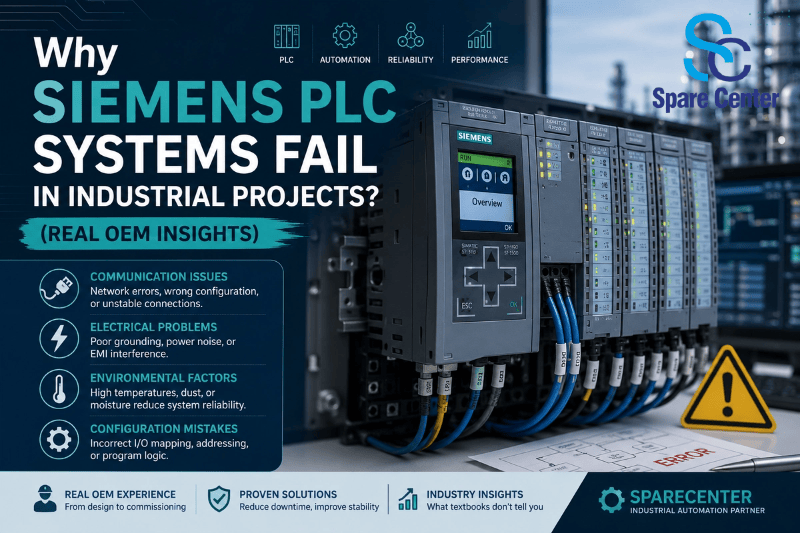
Most Siemens automation system failures are NOT logic failures.
They are physical-world integration failures:
Cable shielding not properly grounded
ET200 modules installed in high-EMI environments
PROFIBUS termination resistors incorrectly configured
CP communication overload in high polling systems
Here’s the problem: many engineers assume Siemens systems are “plug and play.” In reality, they are extremely sensitive to network topology and grounding discipline.
We once reviewed a factory in Vietnam where random S7-1500 communication faults occurred every 3–4 hours. The root cause? A 20-meter unshielded cable running parallel to a VFD power line. Simple mistake, big headache.
How Siemens S7-400 Rack 9 Slot Architecture Works in Practice
The Siemens S7-400 rack 9 slot technical specification is often misunderstood.
In theory, it is just a backplane system. In practice, it is the backbone of deterministic control timing.
A typical configuration includes:
CPU slot (central processing)
CP communication module
Multiple Siemens I/O module cards
What many buyers overlook is slot loading behavior. If high-load modules are placed too close without proper thermal spacing, you get intermittent backplane instability.
We’ve seen this in steel plant automation systems where S7-400 racks were packed too aggressively inside non-ventilated cabinets.
How to Configure Siemens ET200 Distributed I/O System (Real OEM View)
The Siemens ET200 distributed I/O system is extremely powerful—but also extremely easy to misconfigure.
In real projects, the most common mistakes are:
Wrong node addressing in PROFINET
Mixed baud rate assumptions in PROFIBUS DP
Incorrect module grouping (digital + analog mixed without segmentation)
Here’s what many engineers miss:
ET200 is not just “remote I/O.” It is a real-time extension of the PLC brain.
If network latency exceeds design assumptions, you don’t just get delays—you get unstable control loops.
Siemens S7-1500 PLC Programming in TIA Portal Tutorial (Reality Gap)
Everyone searches for Siemens S7-1500 PLC programming in TIA Portal tutorial, but most tutorials ignore real industrial constraints.
In real projects:
Network scan cycles matter more than code elegance
OB structure stability matters more than function blocks
Watchdog timing is more important than logic optimization
Honestly, this is where many junior engineers struggle. The program works in simulation but fails under real load because scan cycle jitter was never considered.
OEM/ODM Perspective: What Factories Don’t Tell You
From an OEM manufacturing point of view, Siemens systems are often integrated into:
Skid-mounted compressor control systems
Water treatment automation panels
Energy distribution cabinets
We’ve seen a recurring issue: OEMs focus too much on system design and ignore cabinet-level heat dissipation.
One real case: a Siemens automation system installed in a tropical environment failed repeatedly due to internal cabinet temperature exceeding 55°C. The PLC itself was fine. The environment wasn’t.
FAQ – Siemens PLC Real Engineering Questions
Q1: Why does a Siemens PLC system fail even when hardware is new?
Because most failures come from wiring, grounding, or communication topology—not hardware defects.
Q2: What is the most common Siemens CPU module issue in field applications?
Network communication instability caused by improper CP module configuration or overloaded PROFINET traffic.
Q3: How important is Siemens I/O module placement inside an S7-400 rack?
Very important. Slot positioning affects thermal behavior and backplane communication stability.
Q4: Why does Siemens ET200 distributed I/O system lose communication intermittently?
Usually due to cable shielding issues, wrong termination, or EMI from nearby drives.
Q5: What causes failure in Siemens S7-1500 PLC programming projects?
Incorrect cycle time assumptions and poor real-time task scheduling inside TIA Portal.
Q6: Is Siemens S7-400 rack 9 slot configuration still used in modern plants?
Yes, especially in power generation and legacy DCS hybrid systems.
Q7: What is the biggest misunderstanding about Siemens automation system design?
That it is “software-driven only.” In reality, 70% of failures are electrical or environmental.
Conclusion
A Siemens PLC system is extremely robust—but only when designed with real-world engineering discipline.
In industrial projects, success is rarely about choosing the right CPU module or writing perfect logic. It’s about understanding how Siemens CPU modules, Siemens I/O modules, and Siemens communication modules CP behave under real electrical, thermal, and network stress.
Here’s the takeaway:
If you treat Siemens automation as purely digital engineering, you will face unpredictable failures.
If you treat it as a full electro-mechanical system, it becomes one of the most stable platforms in industrial automation.
Recommendation
| 6ES5434-4UA11 | 6ES7288-3AR04-0AA0 | 6GK1561-4AA02 |
| 6ES5441-4UA14 | 6ES7412-2XG00-0AB0 | 16267-1/4 |
| 6ES5454-4UA13 | 6DS1916-8RR | 6ES7135-0HF01-0XB0 |
| 6ES5465-4UA12 | 6SN1118-0DK23-0AA2 | 383VA21N1F |
| 6ES5470-4UC12 | 6GK1901-1BB10-2AE0 | 39ACM14CAN |
| 6AV6647-0AK11-3AX0 | 6DD1660-0BJ0 | 39PSMNAN |
| 6AV6648-0CE11-3AX0 | 6DD1661-0AE0 | 39PSR4ANDN 16114-200/01 |
| 6DD1681-0CA2 | 6DD1640-0AD0 | 39RTMCAN |
| 6DD1601-0AE0 | 6FC5370-4AM20-0AA0 | 39VIMCBN |
| 6DD1688-0AD0 | 6FC5370-8AA20-0AA0 | 39VIMCCN |
If you want to more details,please contact me without hesitate.Email:sales@sparecenter.com
Siemens PLC Siemens PLC Siemens PLC Siemens PLC Siemens PLC Siemens PLC Siemens PLC Siemens PLC Siemens PLC Siemens PLC Siemens Siemens PLC Siemens PLC Siemens PLCPLC Siemens PLC Siemens PLC Siemens PLC Siemens PLC Siemens automation system Siemens automation system Siemens automation system Siemens automation system Siemens automation system Siemens automation system Siemens I/O module Siemens I/O module Siemens I/O module Siemens I/O module Siemens I/O module Siemens I/O module Siemens I/O module Siemens I/O module Siemens I/O module Siemens I/O module Siemens I/O module Siemens communication module CP Siemens communication module CP Siemens communication module CP Siemens communication module CP Siemens communication module CP Siemens communication module CP Siemens communication module CP Siemens communication module CP Siemens communication module CP