

Written by Tina Jiang, Director at Spare Center
Tina Jiang is the Sales Director at Spare Center and brings more than 12 years of experience in the automation industry. Over the years, she has worked closely with a wide range of clients and gained a practical understanding of automation technologies, market trends, and real-world customer needs.
Her work focuses on building long-term client relationships and supporting business growth across different markets. With a hands-on approach and solid industry experience, she enjoys sharing insights that come from day-to-day work in the field.
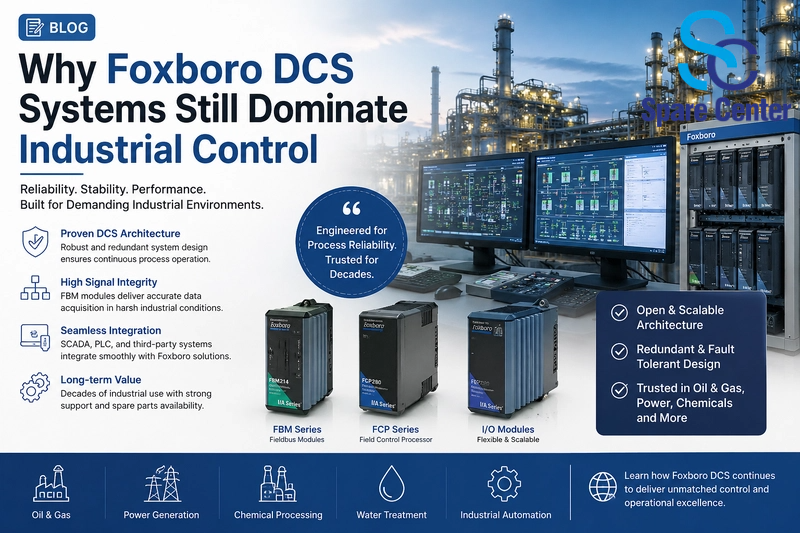
IntroductionA modern industrial plant doesn’t fail because of one big mistake. It usually fails because of small system mismatches that nobody noticed during integration. And this is exactly where Foxboro DCSstill shows up in real-world projects. A Foxboro automation system is not just “old industrial control hardware.” In many oil & gas, power generation, and process plants, it is still the backbone of stable operations. The reason is simple: it was built for reliability first, not trends. We’ve seen this many times in field retrofits—engineers replacing modern PLC-based SCADA systems only to realize the process stability was actually better on Foxboro I/A Series architecture. Here’s the thing. In industrial automation, stability beats novelty every time. What Makes Foxboro DCS System Still Relevant Today?1. Foxboro DCS Architecture Explained in Real TermsWhen people search “Foxboro DCS system architecture explained in detail,” they usually expect a diagram. But in real engineering work, it’s simpler and more practical: A typical Foxboro I/A Series structure includes:
The system is modular, but not “plug-and-play simple.” Honestly, this is where many junior engineers get confused. Because it doesn’t behave like a modern Ethernet PLC system. It behaves like a deterministic process control network. And that difference matters a lot in high-risk environments like refineries. |
|
2. Why Foxboro FBM Still Matters in Field Design
The Foxboro FBM (Fieldbus Module) is often underestimated.
In theory, it’s just an I/O interface module.
In real plants, it becomes the “buffer zone” between unstable field signals and stable control logic.
We’ve seen cases where vibration, long cable runs, and grounding issues caused signal drift in generic PLC systems.
But it's FBM modules were designed with industrial noise isolation in mind.
One engineer once told us:
“We stopped chasing signal noise problems after switching back to Foxboro I/O architecture.”
That kind of feedback is not marketing—it comes from maintenance reality.
3. Foxboro FCP and System Stability Logic
The Foxboro FCP (Field Control Processor) is the decision core of the system.
It handles:
Loop control execution
Redundant logic switching
Process timing synchronization
What many buyers overlook is timing consistency.
In distributed control, a 50ms delay difference can create process instability.
Foxboro systems are not the fastest. But they are consistent. And in process control, consistency is everything.
4. SCADA Integration in Foxboro Environments
Modern plants often ask:
“How does SCADA integration work with Foxboro?”
The answer is: carefully.
Foxboro systems were not originally designed for cloud-style SCADA platforms. Integration typically happens through:
OPC interfaces
Gateway modules
Protocol conversion layers
In real projects, SCADA integration is where things get tricky.
We’ve seen integration failures not because of Foxboro limitations, but because engineers assume all systems behave like Ethernet-based PLCs.
They don’t.
5. OEM/ODM Manufacturing Perspective (What Engineers Care About)
From an OEM/ODM standpoint, Foxboro-based systems are valued for:
Modular replacement strategy
Long lifecycle availability
Stable industrial packaging design
Maintenance-driven architecture
Foxboro components are often categorized into:
Control processors
I/O modules
Communication interfaces
System spare units
What matters here is not just hardware. It’s system continuity.
In industrial manufacturing, downtime costs more than equipment.
Technical Parameters Snapshot (Engineering Reference)
Typical Foxboro DCS-related components follow these engineering ranges:
Control Voltage: 24 VDC / system-dependent AC modules
Communication: Serial + industrial fieldbus protocols
I/O Density: Modular FBM-based expansion
Architecture: Distributed redundant control topology
Environment: Industrial-grade cabinet installation
Operation: 24/7 continuous process control
These are not consumer-level specs. They are designed for plant-level reliability.
Common Engineering Problems in Foxboro Projects
We’ve seen recurring issues in real deployments:
Miswiring FBM modules during retrofit
SCADA mismatch during protocol conversion
Ground loop noise in field instrumentation
Incorrect redundancy configuration in FCP systems
Here’s a real example:
A chemical plant replaced part of its Foxboro system with a hybrid PLC SCADA solution. Everything worked fine during testing. But under full load conditions, loop response time drifted slightly.
That “slight drift” caused temperature instability in a reactor batch process.
Small detail. Big consequence.
FAQs – Foxboro DCS Engineering Questions
Q1: What is Foxboro DCS system architecture explained in detail?
A1: It is a layered distributed architecture consisting of FCP controllers, FBM I/O modules, SCADA interface layers, and field instrumentation networks designed for deterministic process control.
Q2: How does Foxboro I/A Series controller communicate with PLC systems?
A2: Communication is typically achieved through protocol gateways, serial interfaces, or OPC-based integration layers depending on system generation and plant architecture.
Q3: What is the role of Foxboro FBM module configuration and wiring diagram?
A3: FBM modules act as field I/O aggregation points. Wiring diagrams define signal routing, grounding strategy, and channel mapping for stable signal acquisition.
Q4: Why is Foxboro FCP considered stable in industrial automation systems?
A4: Because it prioritizes deterministic execution and redundancy over raw processing speed, ensuring consistent loop control behavior under industrial load.
Q5: Can Foxboro automation system integrate with modern SCADA platforms?
A5: Yes, but typically through middleware such as OPC servers or protocol converters rather than direct native integration.
Q6: What industries still rely on Foxboro I/A Series systems?
A6: Oil & gas, petrochemical plants, power generation facilities, and large-scale continuous process manufacturing environments.
Q7: What are common failure points in Foxboro DCS deployments?
A7: Most issues come from integration errors, wiring mistakes in FBM modules, or incorrect redundancy configuration rather than core system failure.
Conclusion
Foxboro systems are not “legacy” in the way people often assume.
They are stability-first industrial control platforms that still dominate environments where process failure is not an option.
In real engineering projects, the question is not “Is it the newest system?”
It is:
Can it run for years without surprise behavior?
That is where Foxboro DCS, Foxboro I/A Series, and Foxboro automation system architecture still earn their place in modern industrial plants.
Recommendation
| FBM204 | P0916NG | FBI10E P0972AJ |
| FBM207C | FBM222 P0926TL | FBM203 P0914SV |
| FBM214 | FBM201 RH914SQ | FBM206 |
| FBM215 | FCP280 | P0916AG |
| FBM216B P0927AJ | FBM232 | P0926JM |
| FBM231 | B0123HE | P0916AA |
| P0926MX | CP30 P0960AW | P0916CC |
| FBM202 P0926EQ | CP30B P0961EF | FBM205 P0914XG |
| FBM201 P0914SQ | CP40 P0960JA | FBM223 P0917HD |
| FCP270 P0917YZ | CP40B P0961BC | P0916DB |
Foxboro DCS Foxboro DCS Foxboro DCS Foxboro DCS Foxboro DCS Foxboro DCS Foxboro DCS Foxboro DCS Foxboro DCS Foxboro DCS Foxboro DCS Foxboro DCS Foxboro DCS Foxboro DCS Foxboro DCS Foxboro I/A Series Foxboro I/A Series Foxboro I/A Series Foxboro I/A Series Foxboro I/A Series Foxboro I/A Series Foxboro I/A Series Foxboro I/A Series Foxboro I/A Series Foxboro I/A Series Foxboro automation system Foxboro automation system Foxboro automation system Foxboro automation system Foxboro automation system Foxboro automation system Foxboro automation system Foxboro FCP Foxboro FCP Foxboro FCP Foxboro FCP Foxboro FCP Foxboro FCP Foxboro FCP Foxboro FCP Foxboro FCP Foxboro FCP Foxboro FCP Foxboro FCP Foxboro FCP Foxboro FCP Foxboro FCP Foxboro FCP Foxboro FCP Foxboro FCP Foxboro FCP Foxboro FCP Foxboro FCP Foxboro FCP Foxboro FCP
If you want to more details,please contact me without hesitate.Email:sales@sparecenter.com