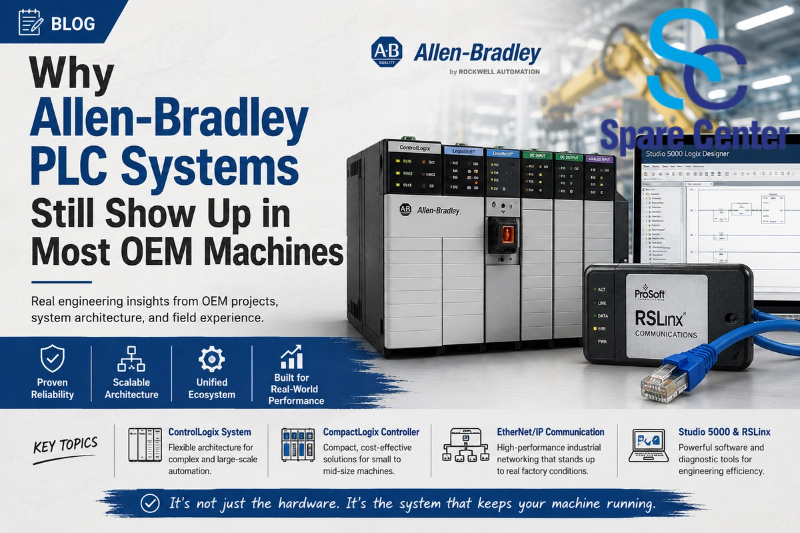

Why Allen-Bradley PLC Systems Still Show Up in Most OEM Machines

2026-05-27


Written by Tina Jiang, Director at Spare Center

Tina Jiang is the Sales Director at Spare Center and brings more than 12 years of experience in the automation industry. Over the years, she has worked closely with a wide range of clients and gained a practical understanding of automation technologies, market trends, and real-world customer needs.

Her work focuses on building long-term client relationships and supporting business growth across different markets. With a hands-on approach and solid industry experience, she enjoys sharing insights that come from day-to-day work in the field.


Introduction

A PLC is supposed to be the brain of a machine. In reality, it’s more like the thing everything argues with when production starts.

In most OEM projects, Allen-Bradley PLC systems (Rockwell Automation) still appear again and again—especially ControlLogix system and CompactLogix controller setups.

It’s not always the cheapest option. And it’s definitely not the simplest.

But it tends to behave the same way every time you power it up. And in a factory, that matters more than people like to admit.

Why engineers keep choosing Allen-Bradley

This is usually where theory and reality start to drift apart.

On paper, most PLC platforms don’t look that different. Same basic idea: controller, I/O, network, logic.

But in actual OEM work, engineers don’t really talk like that.

What you hear more often is:

“Yeah… we used it before. It worked. So we kept it.”

That’s basically how a lot of Rockwell Automation Allen-Bradley PLC system decisions happen.

Everything sits in one ecosystem:

  • ControlLogix / CompactLogix hardware

  • Studio 5000 Logix Designer (most people still say RSLogix 5000 out of habit)

  • EtherNet/IP network

  • RSLinx communication driver for diagnostics

It’s not perfect. But it’s consistent. And consistency is underrated.

Allen-Bradley


ControlLogix system in real machines

If you read the datasheet, ControlLogix system architecture sounds very clean and modular.

In real machines, it never stays clean for long.

A typical OEM machine starts simple:

  • one controller

  • a few remote I/O racks

Then reality kicks in:

  • safety system gets added later

  • a servo package from a different vendor shows up

  • maintenance asks for remote access

  • production wants more sensors

Before you know it, the system has grown into something nobody originally designed.

ControlLogix handles that kind of mess better than most systems. Not because it prevents complexity, but because it doesn’t fall apart when complexity shows up.

That’s really the point.


CompactLogix: simple choice, not always simple behavior

CompactLogix usually goes into smaller machines—packaging lines, filling systems, conveyors.

People often assume small system = easy project. That’s not always true.

In practice, CompactLogix controller programming with Studio 5000 Logix Designer step by step quickly turns into something else:

  • task scheduling gets ignored early on

  • tags grow without structure

  • communication load is never really calculated

And then you get these “soft problems.”

No alarms. No faults.

Just a machine that occasionally hesitates for half a second. Hard to explain, easy to feel.

One case I remember: everything checked out individually. PLC logic fine, I/O fine, drives fine.

Turned out it was just task timing combined with network load. Nothing dramatic. Just poorly balanced design.


EtherNet/IP in real factory conditions

EtherNet/IP sounds very clean in theory. CIP-based, real-time capable, widely supported.

And it is… in controlled conditions.

But in real factories, things get messy fast.

When people ask how EtherNet/IP communication works in Allen-Bradley PLC networks, the textbook answer is CIP objects and cyclic messaging.

The field answer is more like:

“It depends who installed the network.”

Because you’ll see things like:

  • unmanaged switches still in use

  • random network loops

  • mixed industrial and office hardware

  • inconsistent shielding practices

We once saw a system randomly freeze every few hours. Turned out someone added a cheap office switch during maintenance.

Nobody documented it. Of course.


RSLogix 5000 legacy systems are still everywhere

Even today, you’ll still run into:

  • PLC-5 systems

  • SLC 500 systems

  • older RSLogix 500 legacy system installations

And most of them are still running production.

People don’t upgrade just because newer technology exists. They upgrade when they absolutely have to.

Because rewriting a working system is risky. And in manufacturing, risk is expensive.

That’s why a lot of RSLogix 5000 programming logic is still being maintained instead of replaced.


The part nobody talks about: RSLinx issues

Not every problem comes from logic or hardware.

Sometimes the PLC is fine. The machine is fine. Everything looks correct.

And still, something feels off.

In more than a few cases, the issue came down to:

  • misconfigured RSLinx communication driver

  • duplicated IP addresses

  • noisy network traffic

  • unclear routing paths

These are the kinds of problems that don’t show up as obvious faults. They just slow everything down in a way that’s hard to trace.

And debugging them usually takes longer than anyone expects.


FAQ


Q1: Where is Allen-Bradley PLC used most often?

Mostly in industrial automation—OEM machines, production lines, and process control systems.


Q2: Why do OEMs still use Rockwell Automation systems?

Because once integrated, the ecosystem is stable and predictable over long production cycles.


Q3: What is ControlLogix system mainly used for?

Large and complex automation systems that need scalability and distributed control.


Q4: Is RSLogix 5000 still used today?

Yes, especially for existing systems. New projects mostly use Studio 5000 Logix Designer.


Q5: Why does EtherNet/IP sometimes cause issues in factories?

Usually not because of the protocol itself, but because of network design and installation practices.


Q6: CompactLogix vs ControlLogix—what’s the real difference?

CompactLogix is for smaller machines. ControlLogix is for larger, more expandable systems.


Conclusion

If you only look at specifications, most PLC systems don’t seem that different.

But once they’re in production—running 24/7 under real load, real wiring, real people—differences start to show.

Allen-Bradley PLC systems are still widely used not because they’re flawless, but because they tend to stay predictable when everything around them becomes unpredictable.

And in real manufacturing, that’s usually what keeps them in the design.


Recommendation

1756-TBCH1336F-BRF50-AA-EN1734-ACNR
1203-CN11336F-BRF75-AE-DE1746-BTM
1203-GD11336-L6/B1746-FIO4V
1203-GU61336-QOUT-SP13A1746-HS
1305-BA01A-HA21336-QOUT-SP19A1746-HSRV
1305-BA03A1361-NO61-2-51746-HT
1305-BA09A-HA21394C-AM041746-IH16
1336-BDB-SP30D1394C-AM071746-IO12
1336-BDB-SP6A1492-XIM4024-16R1746-IO8
1336F-B025-AA-EN15-131623-001746-ITB16

Allen-Bradley Allen-Bradley Allen-Bradley Allen-Bradley PLC systems Allen-Bradley PLC systems Allen-Bradley PLC systems Allen-Bradley PLC systems Allen-Bradley PLC systems Allen-Bradley PLC systems Allen-Bradley PLC systems Allen-Bradley PLC systems Allen-Bradley PLC systems Allen-Bradley PLC systems Rockwell Automation Rockwell Automation Rockwell Automation Rockwell Automation Rockwell Automation Rockwell Automation Rockwell Automation Rockwell Automation Rockwell Automation ControlLogix system ControlLogix system ControlLogix system ControlLogix system ControlLogix system ControlLogix system  ControlLogix system ControlLogix system ControlLogix system RSLogix 500 legacy system RSLogix 500 legacy system RSLogix 500 legacy system RSLogix 500 legacy system RSLogix 500 legacy system RSLogix 500 legacy system RSLogix 500 legacy system RSLogix 500 legacy system RSLogix 500 legacy system RSLogix 500 legacy system


If you want to more details,please contact me without hesitate.Email:sales@sparecenter.com 


Get the latest price? We will reply as soon as possible (within 12 hours)

Sparecenter sells new and surplus products and develops channels for purchasing such products. This website has not been approved or recognized by any of the listed manufacturers or trademarks. Sparecenter is not an authorized distributor, dealer, or representative of the products displayed on this website. All product names, trademarks, brands, and logos used on this website are the property of their respective owners. The description, explanation, or sale of products with these names, trademarks, brands, and logos is for identification purposes only and is not intended to indicate any association with or authorization from any rights holder.
("[type='submit']")