

Written by Tina Jiang, Director at Spare Center
Tina Jiang is the Sales Director at Spare Center and brings more than 12 years of experience in the automation industry. Over the years, she has worked closely with a wide range of clients and gained a practical understanding of automation technologies, market trends, and real-world customer needs.
Her work focuses on building long-term client relationships and supporting business growth across different markets. With a hands-on approach and solid industry experience, she enjoys sharing insights that come from day-to-day work in the field.
IntroductionA Honeywell automation system is designed to improve industrial control accuracy, safety monitoring, and building efficiency. In theory, it’s stable, scalable, and widely used across factories, airports, and commercial buildings. But here’s the thing. In real projects, failures rarely come from the core Honeywell technology itself. Most issues come from system integration, wrong product selection, or unrealistic engineering assumptions during deployment. We’ve seen this pattern again and again in OEM/ODM projects and industrial upgrades. A Honeywell automation system improves operational reliability through sensors, controllers, and connected software—but only when the surrounding engineering decisions are done correctly. What Honeywell Solutions Actually Cover in Real ProjectsWhen people sayHoneywell, they often think only about thermostats or sensors. But in real engineering environments, it goes much deeper. Typical Honeywell solutions include:
What many buyers overlook is that Honeywell is not just a “product brand”—it’s an ecosystem. And ecosystems fail when even one layer is mismatched. |
|
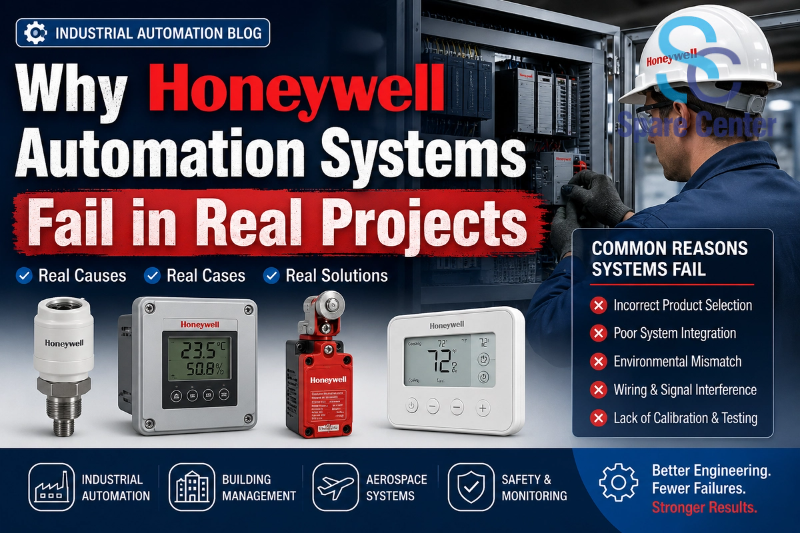
Here’s the Problem: Most Failures Happen at Integration Level
Honestly, this is where many buyers get confused.
On paper, two systems may look identical. Same specs. Same brand. Same datasheet.
In actual projects, though, the environment changes everything.
We’ve seen cases like:
Sensors installed too close to vibration-heavy machinery → unstable readings
Wrong shielding design for signal cables → noise interference
PLC logic mismatch with Honeywell input response time
Poor grounding in OEM cabinet builds → intermittent system resets
One factory in Southeast Asia installed Honeywell sensors in a humid packaging environment. The sensors were fine. The issue? Condensation inside the enclosure due to wrong IP-rated housing selection.
This is not a product failure. This is an engineering gap.
Honeywell Sensors and Why Selection Matters
Honeywell sensors are widely used in:
Pressure monitoring systems
Gas detection environments
Temperature control loops
Airflow measurement in HVAC systems
But here’s what OEM engineers know:
Small sensor mismatches create big system instability.
For example:
A 0–10V output sensor used where a 4–20mA loop is required → signal distortion
Fast-response sensors installed in slow thermal systems → false alarms
Industrial dust exposure without proper filtering → drift over time
What many buyers overlook is calibration strategy. Not the sensor itself.
Honeywell Safety Products in Industrial Environments
Honeywell safety products are often deployed in:
Chemical plants
Oil & gas facilities
Manufacturing floors
Warehouse fire safety systems
These systems include alarms, detectors, and integrated shutdown logic.
But here’s something rarely discussed:
Most safety system “failures” are actually response-chain failures.
Example:
Sensor detects gas leak correctly
PLC delays trigger signal due to logic buffering
Alarm activates too late
The sensor did its job. The system design didn’t.
Honeywell Thermostat and Building Automation Reality
Honeywell thermostat systems are popular in commercial HVAC projects.
But in real buildings:
Wrong zoning design causes temperature imbalance
Over-centralized control creates lag response
Retrofit projects suffer from legacy wiring conflicts
We once saw a hotel project where guest complaints increased after upgrading to smart thermostats. The issue wasn’t control accuracy—it was airflow design mismatch between floors.
This is where things get tricky.
OEM/ODM Perspective: What Spare Center Does Differently
When working with OEM/ODM suppliers like Spare Center, the real value is not just product supply—it’s system alignment.
Typical OEM/ODM capabilities include:
Custom enclosure design for industrial controllers
Sensor integration into third-party automation systems
Packaging designed for vibration, humidity, and export logistics
Hardware adaptation for different voltage standards
Private labeling for industrial distributors
From an engineering standpoint, packaging is not “just packaging”.
We’ve seen leakage issues and signal failures appear only after long-distance shipping vibration tests—especially in poorly reinforced OEM assemblies.
That’s why industrial packaging design is part of system reliability, not an afterthought.
Honeywell Aerospace Technology Context (Why It Matters)
Honeywell also plays a major role in aerospace systems.
Examples include:
Honeywell avionics systems used in commercial aircraft
Honeywell APU functions in aviation (Auxiliary Power Units for backup power)
Honeywell aerospace technology overview in navigation and flight control systems
In aviation, failure tolerance is almost zero.
That mindset is slowly influencing industrial automation design: redundancy, predictive diagnostics, and fault isolation are becoming standard expectations.
Common Mistakes in Honeywell Automation Projects
Here’s what we keep seeing in real deployments:
Over-specifying hardware but under-designing logic
Ignoring environmental conditions (dust, humidity, vibration)
Mixing incompatible communication protocols
Skipping field calibration after installation
Assuming “plug-and-play” in industrial environments
Most of these are not product issues—they are system engineering oversights.
FAQ (5–8 Practical Questions)
1. Why do Honeywell automation systems fail in real projects?
Most failures come from integration issues, incorrect sensor selection, or poor environmental adaptation—not the coreHoneywell hardware.
2. Are Honeywell sensors suitable for harsh environments?
Yes, but only when correctly selected with proper IP rating, shielding, and calibration strategy.
3. What industries use Honeywell solutions most?
Manufacturing, building automation, oil & gas, aerospace, logistics, and energy systems.
4. What is the role of OEM/ODM in Honeywell -based systems?
OEM/ODM providers customize housing, integration, and packaging to ensure system compatibility in real-world environments.
5. Can Honeywell thermostat systems be used in retrofit buildings?
Yes, but success depends heavily on HVAC design compatibility and wiring architecture.
6. What is Honeywell APU used for in aviation?
Honeywell APU systems provide auxiliary power for aircraft during ground operations and backup scenarios.
7. Why do some Honeywell systems show unstable readings?
Common reasons include wiring noise, improper grounding, environmental interference, or incorrect sensor configuration.
8. Is Honeywell suitable for smart factory upgrades?
Yes, especially when combined with proper PLC integration and industrial IoT architecture.
Conclusion
In real engineering projects, Honeywell systems are rarely the weak point.
The real challenge lies in how systems are designed, integrated, and adapted to actual environments.
If there’s one takeaway from OEM/ODM experience, it’s this:
hardware performance matters—but system engineering determines success.
And that’s exactly where most automation projects either succeed quietly or fail unexpectedly.
Recommendation
| 51304685-150 | 51401135-300 | MU-TAMR03 51309218-125 |
| 51305896-200 | 80363972-100 | MU-TAMT03 51309223-125 |
| 51401286-100 | MU-TAIH02 51304453-100 | 51198651-100 SPS5785 |
| 51402755-100 K4LCN-4 | MU-TLPA02 51309204-125 | 51401496-100 |
| 51303979-500 | 51401632-100 | MC-TAOX12 51304335-125 |
| 51304485-100 | 51402592-100 | MU-TAOX12 51304335-100 |
| 51304493-200 | 51304362-100 MU-PLAM02 | MC-PAOX03 51309152-175 |
| 51304518-100 | 51304487-100 MU-PDOX02 | MU-PAOX03 51304672-100 |
| 51304685-100 | 51309152-175 MC-PAOX03 | MU-PLAM02 51304362-100 |
| 51304690-100 | 51304754-150 MC-PAIH03 | 51401642-150 |
If you want to more details,please contact me without hesitate.Email:sales@sparecenter.com
Honeywell automation Honeywell automation Honeywell automation Honeywell automation Honeywell automation Honeywell automation Honeywell automation Honeywell automation Honeywell automation Honeywell automation Honeywell automation Honeywell sensors Honeywell sensors Honeywell sensors Honeywell sensors Honeywell sensors Honeywell sensors Honeywell sensors Honeywell sensors Honeywell sensors Honeywell sensors Honeywell sensors Honeywell sensors Honeywell sensors Honeywell sensors Honeywell sensors Honeywell safety products Honeywell safety products Honeywell safety products Honeywell safety products Honeywell safety products Honeywell safety products Honeywell safety products Honeywell safety products Honeywell safety products Honeywell safety products Honeywell safety products Honeywell thermostat Honeywell thermostat Honeywell thermostat Honeywell thermostat Honeywell thermostat Honeywell thermostat Honeywell thermostat Honeywell thermostat Honeywell thermostat Honeywell thermostat Honeywell thermostat Honeywell thermostat Honeywell thermostat