

Written by Tina Jiang, Director at Spare Center
Tina Jiang is the Sales Director at Spare Center and brings more than 12 years of experience in the automation industry. Over the years, she has worked closely with a wide range of clients and gained a practical understanding of automation technologies, market trends, and real-world customer needs.
Her work focuses on building long-term client relationships and supporting business growth across different markets. With a hands-on approach and solid industry experience, she enjoys sharing insights that come from day-to-day work in the field.
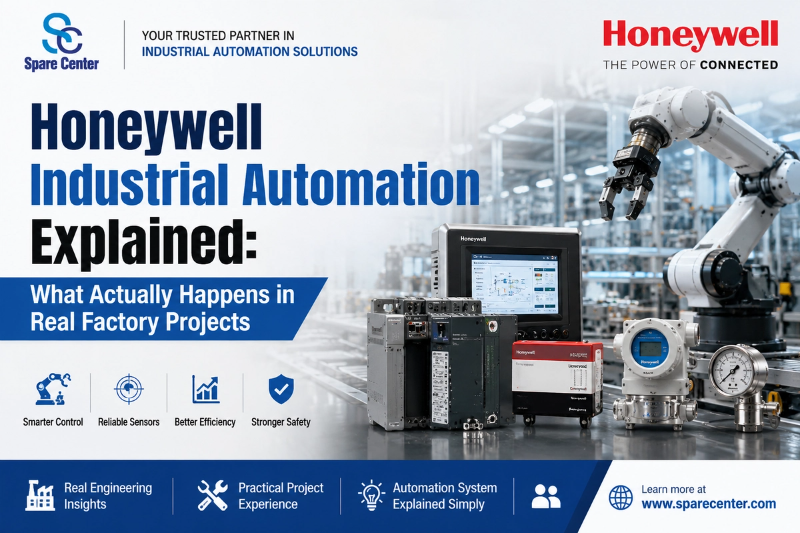
IntroductionWhen people search for Honeywell or Honeywell International, most of the time they’re just trying to figure out one thing: is this system really reliable in a real factory environment? On paper, Honeywell industrial automation looks very clean. Sensors talk to controllers, controllers talk to software, everything looks stable. But in actual projects—especially in Southeast Asia factories or retrofit lines—things are rarely that neat. We’ve seen cases where two systems with almost identical specs perform completely differently after installation. Same brand, same model family. Different result. Here’s the uncomfortable truth: What Honeywell Industrial Automation Really Means in PracticeIn theory, Honeywell industrial automation includes sensors, controllers, monitoring systems, and software platforms. But in real factory language, it usually means:
A typical Honeywell control systems setup might include:
Honestly, this is where many buyers misunderstand the system. They think they are buying a “device.” And real-world noise is always worse than datasheet conditions. |
|
WhyHoneywell Sensors Perform Differently in Real Plants
Let’s talk about Honeywell sensors.
On spec sheets, everything looks precise—temperature accuracy, pressure range, response time.
But in factories, none of that matters if installation is wrong.
We once saw a chemical mixing line where temperature deviation caused inconsistent batch quality. The sensor itself was fine. The issue came from calibration drift after months of operation.
This is something many engineers learn the hard way.
A sensor doesn’t fail suddenly. It usually fails quietly over time.
In Honeywell industrial sensors applications in manufacturing, you’ll usually see:
Pressure monitoring in hydraulic systems
Temperature control in reactors
Gas detection in safety zones
Flow control in pipelines
But here’s what datasheets never tell you:
Vibration, humidity, and grounding issues will destroy accuracy long before the sensor reaches its theoretical limit.
We’ve even seen cases where shipping vibration alone caused intermittent signal drift after installation.
The Real Problem in Honeywell Control Systems Projects
If you ask experienced engineers what actually breaks automation projects, they rarely say “hardware failure.”
It’s usually integration.
Honeywell control systems are strong in architecture, but real factories introduce complexity like:
Mixed legacy systems
Poorly labeled wiring
Signal interference from nearby machines
Unstable grounding
Here’s the thing.
Two devices may both support Modbus.
But that doesn’t mean they will behave nicely in the same network.
We’ve seen a 200ms delay between sensor feedback and actuator response completely destabilize a conveyor system.
Not becauseHoneywell failed—but because timing assumptions didn’t match reality.
This is where things get tricky.
How Does a Honeywell Thermostat Work in Real Life?
People often search: how does Honeywell thermostat work
In theory:
Sensor measures temperature
Controller compares with setpoint
System adjusts HVAC output
Terror=Tsetpoint−Tmeasured
Simple enough.
But in real buildings or warehouses, this is what actually happens:
Heat from machines keeps leaking into the environment
Airflow is uneven across zones
Sensors are placed where maintenance is convenient, not where airflow is correct
So the thermostat ends up “technically correct” but practically unstable.
We’ve seen HVAC systems constantly overshooting setpoints just because the sensor was mounted too close to an exhaust airflow path.
Honeywell Automation System for Factories (Real Breakdown)
A real Honeywell automation system for factories explained usually looks like this:
1. Field Layer (where reality is messy)
Sensors exposed to heat, dust, vibration
Actuators working under mechanical stress
2. Control Layer (where logic lives)
PLC / DCS logic
Safety interlocks
Process timing rules
3. Monitoring Layer (what humans see)
SCADA screens
Alarm systems
Historical logs
4. Digital Layer (modern systems)
Predictive maintenance
Energy optimization
Remote dashboards
But here’s what most people don’t realize:
Systems don’t fail at one layer. They fail between layers.
A perfectly good Honeywell sensor can still produce wrong decisions if mapping, scaling, or calibration between layers is off.
OEM/ODM Engineering View: What Actually Matters
From an OEM/ODM perspective, especially in industrial products similar to Honeywell company systems, specs are only half the story.
What really matters is:
PCB stability under long operation
EMI shielding in noisy environments
Connector durability after vibration cycles
Housing sealing under humidity and heat
Long-term calibration drift behavior
We’ve seen failures that had nothing to do with electronics.
One case:
Packaging foam absorbed moisture during shipping, which later affected connector stability inside control units.
Another case:
Cable routing was done too close to a high-power drive system—resulting in unstable sensor readings.
These are not “product defects.”
They are engineering reality gaps.
Real Factory Truth (What No One Writes Clearly)
If we’re honest:
Most automation failures are installation-related
A large portion are integration-related
Very few are true product failures
This is whyHoneywell International systems are often seen as “reliable in principle” but still fail in some real deployments.
We’ve seen factories blame the system when the actual issue was:
Ground loop noise
Incorrect shielding
Wrong sensor placement
Poor signal isolation
FAQ
1. What does Honeywell do in industrial automation?
It provides sensors, control systems, and software platforms for industrial process automation.
2. Is Honeywell company focused on hardware or software?
Both. It operates across industrial hardware and digital software platforms.
3. Where is Honeywell industrial automation used?
Factories, energy systems, chemical plants, and building automation systems.
4. Are Honeywell sensors always accurate?
They are accurate under proper installation and calibration conditions. Environment matters a lot.
5. Why do automation systems fail in factories?
Usually due to integration, wiring, grounding, or environmental mismatch—not hardware failure.
6. What is Honeywell control systems used for?
Process control, industrial automation, safety monitoring, and system coordination.
7. How does a Honeywell thermostat actually behave in real environments?
It adjusts HVAC based on feedback loop control, but placement and airflow heavily affect stability.
8. Is Honeywell International suitable for large factories?
Yes, especially for complex industrial automation setups with multi-layer control systems.
Conclusion
At the end of the day, Honeywell is not just a product brand—it’s a system architecture used in real industrial environments.
But real factories don’t care about architecture diagrams.
They care about stability, uptime, and whether the system still behaves correctly after months of vibration, heat, and human intervention.
And that’s the real gap between “industrial automation theory” and “industrial automation reality.”
Recommendation
| 51304685-150 | 51401135-300 | MU-TAMR03 51309218-125 |
| 51305896-200 | 80363972-100 | MU-TAMT03 51309223-125 |
| 51401286-100 | MU-TAIH02 51304453-100 | 51198651-100 SPS5785 |
| 51402755-100 K4LCN-4 | MU-TLPA02 51309204-125 | 51401496-100 |
| 51303979-500 | 51401632-100 | MC-TAOX12 51304335-125 |
| 51304485-100 | 51402592-100 | MU-TAOX12 51304335-100 |
| 51304493-200 | 51304362-100 MU-PLAM02 | MC-PAOX03 51309152-175 |
| 51304518-100 | 51304487-100 MU-PDOX02 | MU-PAOX03 51304672-100 |
| 51304685-100 | 51309152-175 MC-PAOX03 | MU-PLAM02 51304362-100 |
| 51304690-100 | 51304754-150 MC-PAIH03 | 51401642-150 |
Honeywell automation system Honeywell automation system Honeywell automation system Honeywell automation system Honeywell automation system Honeywell automation system Honeywell automation system Honeywell automation system Honeywell automation system Honeywell automation system Honeywell company Honeywell company Honeywell company Honeywell company Honeywell company Honeywell company Honeywell company Honeywell company Honeywell company Honeywell company Honeywell company Honeywell company Honeywell company Honeywell company Honeywell company Honeywell company Honeywell company Honeywell company industrial automation industrial automation industrial automation industrial automation industrial automation industrial automation Honeywell sensors Honeywell sensors Honeywell sensors Honeywell sensors Honeywell sensors Honeywell sensors Honeywell sensors Honeywell sensors Honeywell sensors Honeywell sensors Honeywell sensors Honeywell sensors Honeywell sensors Honeywell sensors Honeywell sensors Honeywell sensors Honeywell sensors Honeywell sensors
If you want to more details,please contact me without hesitate.Email:sales@sparecenter.com